
CPR & AED training across India
CPR & AED Training for Employees in India
CPR and AED training teaches employees to recognise sudden cardiac arrest, call for help, give effective chest compressions and use an automated external defibrillator (AED) within minutes — the actions that most affect whether a colleague who collapses survives until the ambulance arrives. Plan My Health runs hands-on CPR and AED training for offices, factories and sites across India, with certificates and refresher tracking.
This page goes deeper than the CPR module in our general first aid course: more practice, AED use and placement, choking, floor warden response plans and refresher planning.
About 10 years in corporate health · PAN-India delivery · Trusted by teams at









Available across India, by state
Maharashtra
Delhi, Haryana and Uttar Pradesh
Karnataka
Tamil Nadu
Telangana
By site type
Why CPR and AED skills matter at work
When someone's heart stops, the brain starts to suffer damage within minutes, and an ambulance in an Indian city can take much longer than that to arrive, especially at peak hours or on an upper floor of a large building. What happens before it arrives depends entirely on the people nearby: whether they recognise what is happening, start compressions, and bring an AED. Training turns bystanders into a response team.
What the course covers
- Recognising cardiac arrest: unresponsive, not breathing normally
- Calling for help and sending someone for the AED, with clear roles
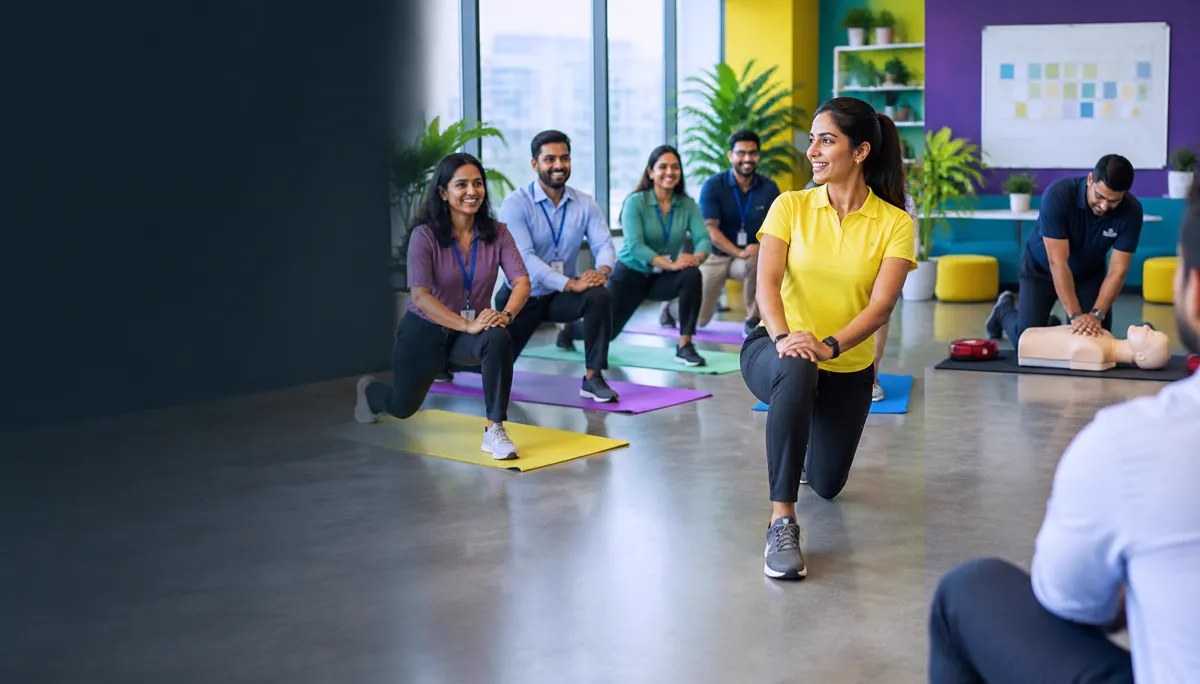
- Adult chest compressions: hand position, depth, rate and full recoil, practised on manikins
- Rescue breaths where trainees are willing and able, and compression-only CPR
- AED use: switching on, pad placement, following prompts and continuing CPR
- Choking in adults: recognising it, back blows and abdominal thrusts
- Recovery position for a breathing casualty
- Handover to the ambulance crew or OHC team
Recognising sudden cardiac arrest
Sudden cardiac arrest often happens without warning: the person collapses, does not respond and is not breathing normally. Occasional gasping breaths are common in the first minutes and are easily mistaken for breathing — training teaches employees to treat gasping as a sign to start CPR. Hesitation is the biggest cause of delay, so the course practises the decision as much as the technique.
Compression-only CPR and rescue breaths
For adults, effective chest compressions are the most important part of bystander CPR. Employees who are unwilling or unable to give rescue breaths are taught that compression-only CPR is far better than doing nothing. Those who are willing learn rescue breaths with a face shield. Either way, the course focuses on pushing hard and fast in the centre of the chest with minimal interruptions.
A sample half-day CPR and AED course
- Introduction: cardiac arrest, the chain of survival and why minutes matter
- Demonstration of the full sequence by the trainer
- Compression practice on manikins in short rounds, with feedback on depth and rate
- AED practice with training units: pad placement, prompts and safety
- Team scenarios: collapse in a meeting room, lift lobby and plant floor
- Choking and recovery position practice
- Practical assessment and certificates
Building a CPR-ready workplace
- Trained people on every floor and shift, recorded by name and certificate date
- AEDs placed so they can be fetched and returned within a few minutes
- A clear call procedure: ambulance number, OHC contact and building security
- Lifts and gates managed so the ambulance crew reaches the casualty quickly
- Regular drills and refreshers
CPR training for security, reception and OHC support staff
Security guards and receptionists are often the first to hear about an emergency and the people who know the building best. Training them in CPR and AED use, along with their role in calling the ambulance and guiding it in, closes the most common gaps. OHC support staff and admin teams who own the AED should also learn its daily checks and maintenance.
Training in English, Hindi and regional languages
Training runs in English and Hindi as standard, with regional languages where trainers are available, so every participant understands the steps under stress. Demonstration-led practice means even employees who are less comfortable with reading or slides learn the technique properly.
Who should be trained first
Train the people most likely to be first on the scene: floor wardens and fire marshals, security and reception staff, canteen and housekeeping supervisors, shift supervisors on the shop floor, drivers and site engineers. Then add volunteers from each floor and shift so that someone trained is always present, including at night and on weekends. A simple roster that maps trained people by floor and shift shows the gaps quickly.
What a practical CPR assessment looks like
Every participant practises on adult manikins until they can deliver compressions at the right depth and rate, give rescue breaths where taught, and switch with a partner without long pauses. They then use a training AED from switch-on to shock and resume CPR. The trainer observes each person, gives individual feedback and records the result. Participants who need more practice repeat the skill before they finish.
After the training: keeping skills alive
- Short refreshers between full courses — CPR skills fade within months without practice
- Mock drills that include calling the ambulance, fetching the AED and handing over to medical staff
- Monthly AED checks of battery, pads and the status indicator
- An updated roster of trained responders after every transfer or resignation
- A debrief after any real incident to improve the response
How this differs from first aid training
Our first aid training for employees is broad: bleeding, burns, fractures, eye injuries, seizures and heat illness, with a CPR module inside it. This CPR and AED course is narrow and deep: almost all of the time is spent on compressions, AED practice and team scenarios, so participants reach a confident, practised level. Many companies train a wide group in first aid and a dedicated group — floor wardens, security, reception and OHC support — in CPR and AED.
AED use in practice
An AED analyses the heart rhythm and tells the user, by voice prompts, whether to deliver a shock. It is designed for untrained people, but trained people use it faster and with less hesitation. Participants practise with training AEDs: opening the case, exposing the chest, placing pads correctly, standing clear during analysis and shock, and resuming compressions immediately. Scenarios include a collapse in a meeting room, in a lift lobby and on the plant floor.
Where to place AEDs at your workplace
- Where a trained person can reach and return with the AED within a few minutes from any point
- Near lifts, reception, cafeterias, gyms and large meeting areas in offices
- Near control rooms, canteens and high-occupancy areas in factories
- At the site office or medical post on construction projects
- In a clearly signed cabinet, not locked in an office, with an inspection tag
- With the location marked on floor plans and included in the emergency plan
Floor wardens and the emergency response team
Floor wardens, fire marshals and security staff are already part of your emergency plan, so they are the natural first group for CPR and AED training. Each floor or zone should have trained people on every shift. The course includes a simple response plan: who starts CPR, who fetches the AED, who calls the ambulance and the OHC, who meets the ambulance at the gate and holds the lift.
CPR and AED training for offices
In offices, the priority is speed through a large building: knowing where the AED is, getting it from the cabinet to the casualty quickly and coordinating with building security for lifts and access. Training can be run floor by floor so each group practises in its own space.
CPR and AED training for factories and sites
In factories and on construction sites, collapses can happen far from the medical room, in noise, heat or at height. Training covers safe approach, moving a casualty only when needed, and linking with the OHC nurse and ambulance. Sessions are planned by shift and delivered in the language workers use.
Refresher frequency
CPR skills fade quickly without practice. Participants should refresh at regular intervals, and short practice sessions between full refreshers help keep compressions effective. We track every trained employee's certificate date and remind HR or EHS when refreshers are due, so coverage on each floor and shift stays current as people move.
Certificates and records
Participants who complete the practical assessment receive a certificate with the course name, date and trainer details. HR receives a digital list of trained employees by location and shift, which can be shared with building management or auditors.
Group size and practice time
Practice time is what makes CPR training work, so groups are kept small enough that every participant gets repeated time on the manikin and the training AED. Larger groups are split into batches across the day.
After the training: drills
A short unannounced drill a few weeks after training tests the whole chain: recognition, AED retrieval time, ambulance call and handover. We run drills with your safety team and share a short report of what slowed the response, such as a locked cabinet or an unclear call procedure.
Sudden cardiac arrest risk and prevention
CPR and AED readiness responds to an emergency; prevention reduces the chance of one. Health risk assessments, checkups with BP, sugar and lipids, and heart-health sessions help employees understand and lower their risk. Together they form a complete heart-safety plan for the workplace.
Frequently asked questions
What is CPR and AED training for employees?
Hands-on training to recognise cardiac arrest, give chest compressions, use an AED and manage choking until professional help arrives.
How is it different from first aid training?
First aid training is broad with a CPR module. CPR and AED training spends almost all its time on compressions, AED use and team scenarios.
Who should be trained in CPR?
Floor wardens, security, reception, OHC support staff and volunteers on every floor and shift.
Do we need an AED to run the training?
No. We bring training AEDs. If you are planning to install AEDs, we help you decide where.
Is AED use covered in the course?
Yes — pad placement, following prompts, safety during shock and resuming CPR.
Does it cover choking?
Yes, adult choking with back blows and abdominal thrusts.
How often should employees refresh CPR skills?
At regular intervals, with short practice in between. We track due dates and remind you.
Do participants receive a certificate?
Yes, after the practical assessment, with records by location and shift.
Can you train in factories and on construction sites?
Yes, by shift and in the workers' language, with scenarios suited to the site.
Can training be done in Hindi?
Yes, and in other regional languages where trainers are available.
Related services
Guides for HR and EHS teams
Cities we serve
Get a quote in 24 hours
Share your headcount and locations — we reply within one working day with a scope and quote.