
Corporate fitness across India
Corporate Fitness Programs in India
A corporate fitness program is a planned mix of activities that helps employees move more, eat better and build fitness habits — starting from a health baseline, then combining guided sessions, team challenges and expert advice over several months. Plan My Health builds corporate fitness programs across India from services we already run: health risk assessments and checkups, corporate yoga, fitness and movement sessions, step and activity challenges on our platform, dietitian-led nutrition sessions and physiotherapist-led ergonomics talks.
This page explains each building block, how to combine them for offices, factories and distributed teams, how the platform tracks challenges and how to measure progress.
About 10 years in corporate health · PAN-India delivery · Trusted by teams at


Available across India, by state
Maharashtra
Delhi, Haryana and Uttar Pradesh
Karnataka
Tamil Nadu
Telangana
Onsite
At your office, plant or site
Online
Live video with joining links
Hybrid
One session, every location
What a corporate fitness program includes
- A baseline: free health risk assessment and, where useful, a checkup with BMI, waist, BP and sugar
- Guided sessions: corporate yoga, desk stretch, functional fitness and strength basics, Zumba-style dance movement and breathwork
- Challenges: step, water, sleep and healthy-weight challenges run on our employee platform
- Nutrition: dietitian-led sessions on weight, diabetes-friendly eating and eating well on shifts
- Ergonomics and back care: physiotherapist-led workstation and posture sessions
- Reporting: participation and anonymised progress for HR
Start with a baseline, not a guess
Many fitness programs fail because they are planned around what is fashionable rather than what employees need. A free health risk assessment shows activity levels, sitting time, weight, sleep and stress across the workforce in about five minutes per person, interpreted on Indian BMI cut-offs. Adding a checkup gives clinical values such as BP and sugar. The anonymised results tell you whether to emphasise movement, weight, back care or stress — and give you a starting point to compare against later.
Why corporate fitness programs matter in India
Many Indian employees sit for most of the working day, commute for long hours and eat irregularly, while factory and site workers often do repetitive, physically demanding work with little recovery. Lifestyle diseases such as diabetes and hypertension tend to appear earlier in South Asians and at lower body weight. A structured fitness program gives employees a reason and a time to move, a sense of team spirit and, combined with checkups and assessments, a way to see whether risk is going down.
Choosing activities from your baseline
- High sitting time and low activity: desk-yoga breaks, walking challenges, functional fitness sessions
- Back, neck and shoulder complaints: ergonomics talks, chair yoga, mobility routines
- Raised BMI and sugar risk: nutrition sessions, step challenges, healthy-weight challenge
- Poor sleep and high stress: breathing and yoga sessions, sleep challenge, stress management workshop
- Physically demanding jobs: shift-start warm-ups, safe lifting, hydration and recovery
Making challenges inclusive
Challenges motivate many people but can exclude others. Use team averages so team size does not decide the winner, reward improvement over each person's own starting point, and offer alternative goals such as water intake, sleep or yoga minutes for employees who cannot walk long distances. Keep daily targets realistic, never reward extreme numbers, and let each employee choose what appears on leaderboards.
Role of managers and leaders
Fitness programs grow when managers take part rather than just forwarding the invitation. A leader who joins the step challenge, attends the first yoga session or starts team huddles with a two-minute stretch gives everyone permission to do the same. Ask each location head to nominate a fitness champion who shares updates and reminders.
Year-round rhythm after the first cycle
- A weekly online or onsite yoga or fitness class
- A quarterly team challenge on the platform
- An ergonomics refresher once or twice a year
- International Yoga Day on 21 June and World Heart Day in September as anchor events
- A repeat health risk assessment every six to twelve months
Making fitness work for shift and site teams
Fitness programmes often fail on the shop floor because they are designed around office hours. For plant and site workers we run short movement and stretching sessions at shift start, focus on back care, lifting technique and hydration rather than gym-style workouts, and use challenges that count steps already walked at work. Night-shift teams get sessions at the start of their shift and sleep guidance for the day after.
For office teams the opposite problem applies: too much sitting. Movement breaks every hour, desk yoga, walking meetings and team step challenges do more for most office staff than an occasional fitness event.
- Start with the HRA and checkup baseline, so each person knows their starting point
- Pick one or two goals per quarter — steps, sleep or weight — rather than everything at once
- Run challenges by team, not only individually, so less active people join in
- Repeat the measurement after 12 weeks and share the anonymised change
Fitness and movement sessions
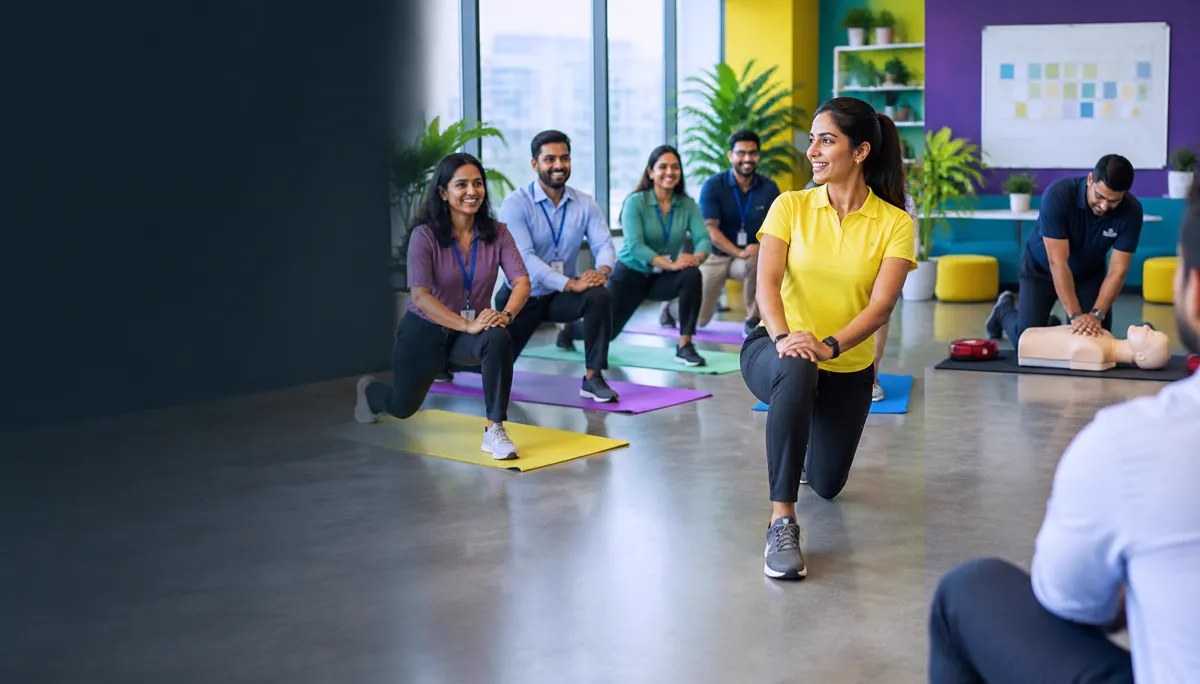
Guided sessions are the visible heart of the program. Functional fitness and strength basics teach safe bodyweight exercises employees can do at home; dance movement sessions bring energy and team spirit; desk stretch and corporate yoga fit into the working day without changing clothes. Sessions are led by certified trainers and instructors and adapted for different fitness levels, with seated alternatives for anyone who needs them.
Yoga as part of a fitness program
Yoga gives a program a low-barrier entry point: it suits beginners, older employees and people who would never join a fitness class. Weekly online morning classes, desk-yoga breaks and an International Yoga Day event on 21 June are easy anchors. Our corporate yoga page covers formats and safety screening in detail.
Step and activity challenges
Our employee platform runs health challenges and contests that HR can set up for teams or the whole company: step challenges, water-intake challenges, sleep challenges and healthy-weight challenges. Steps can be entered as daily tracking entries or counted from a linked fitness app where the employee chooses to connect one. Leaderboards can be by individual or team, and HR sees participation and totals, not personal health records.
Team-based challenges usually work better than individual ones: they pull in people who would not compete alone, and they create conversation at work. Keep targets achievable, celebrate improvement as well as top scores, and offer non-step alternatives — such as yoga minutes — for employees who cannot walk long distances.
Nutrition sessions
Fitness without food habits rarely lasts. Dietitian-led sessions cover reading labels, balanced Indian meals, managing weight without crash diets, eating for diabetes risk, healthy snacking at the desk and eating well on night shifts. Employees can follow up with a personal diet plan through the platform.
Ergonomics and physiotherapy talks
Back, neck and shoulder discomfort are among the most common complaints in offices and on factory floors. Physiotherapist-led sessions cover workstation set-up, posture, safe lifting, micro-breaks and simple mobility exercises. They pair naturally with desk yoga and make the fitness program relevant to people's daily work, not just their free time.
A sample 12-week program
- Weeks 1–2: launch message, HRA baseline, optional checkup camp and a kick-off fitness session
- Weeks 3–6: team step challenge on the platform, weekly online yoga, one nutrition session
- Weeks 7–8: ergonomics and back-care session, desk stretch breaks, water challenge
- Weeks 9–11: functional fitness session, sleep challenge, stress management session
- Week 12: celebration event, repeat HRA for participants and a summary report to HR
Fitness programs for offices
Office programs fight sitting time. Combine desk-yoga breaks, walking meetings, a team step challenge, ergonomics sessions and online morning classes for hybrid staff. Schedule sessions within working hours where possible so participation does not depend on staying late.
Fitness programs for factories and warehouses
Factory and warehouse workers are already physically active, but often in repetitive or awkward postures. Their program focuses on warm-ups and mobility at shift start, safe lifting, back care, hydration, nutrition on shifts and tobacco cessation. Challenges can use water or sleep goals rather than steps, and sessions are delivered on paid time, in the workers' language.
Fitness programs for distributed and field teams
Sales and field teams spread across cities join through online sessions, app-based step and water challenges and partner labs booked by PIN code for their baseline checkup. Short sessions at the start of the day work better than evening classes for people on the road.
Safety first
Employees answer health questions before joining active sessions and are advised to check with their doctor if they have heart disease, uncontrolled blood pressure, diabetes on insulin, recent surgery, pregnancy or joint problems. Trainers offer low-impact alternatives and ask anyone who feels pain, chest discomfort or breathlessness to stop. Challenges never reward extreme targets.
Measuring progress
- Participation in sessions and challenges, by location and team
- Repeat participation over the 12 weeks
- Change in activity, sitting time and weight answers between the baseline and repeat HRA
- Change in anonymised BMI, BP and sugar distribution where a repeat checkup is run
- Employee feedback on energy, comfort and what to keep
Privacy
Challenge leaderboards show only what employees agree to share. Health assessment and checkup results stay with the employee; HR receives anonymised, aggregated progress. This follows the Digital Personal Data Protection Act, 2023.
Frequently asked questions
What is a corporate fitness program?
A planned mix of baseline assessment, guided sessions, team challenges, nutrition and ergonomics advice that helps employees build fitness habits over several months.
Do you provide gym equipment or gym memberships?
No. Our programs are built from assessments, guided sessions, platform challenges and expert talks that need no gym.
Can you run a step challenge?
Yes. Our employee platform runs step, water, sleep and healthy-weight challenges with individual or team leaderboards.
Do employees need a fitness tracker?
No. Steps can be entered as daily entries, or counted from a linked fitness app if the employee chooses.
How long should a fitness program run?
Twelve weeks is a good first cycle, followed by a review and a lighter year-round rhythm.
Which sessions are included?
Corporate yoga, desk stretch, functional fitness and strength basics, dance movement, breathwork, nutrition and ergonomics sessions, chosen from your baseline.
Can factory workers join?
Yes, with shift-start mobility routines, back-care and hydration sessions on paid time in their language.
How do we measure results?
Participation, repeat attendance and anonymised changes in activity, weight and other markers between the baseline and repeat assessment.
Is it safe for employees with health conditions?
Employees answer health questions first, are advised to consult their doctor where needed and get low-impact alternatives.
Will HR see individual employees' health details?
No. Employees see their own results. HR sees anonymised, aggregated data plus any fitness opinion the law requires for specific roles. Anything more is shared only with the employee's consent, in line with the Digital Personal Data Protection Act, 2023.
Related services
Guides for HR and EHS teams
Cities we serve
Get a quote in 24 hours
Share your headcount and locations — we reply within one working day with a scope and quote.