
Guide · Corporate wellness in India
Corporate Wellness in India — Programs That Actually Work
Corporate wellness in India works when it is built on data, runs all year and reaches every kind of employee — not just the office team that already goes to the gym. A good programme starts with a health risk assessment and checkups, adds medical care where it is needed, and uses sessions, challenges and nutrition support to change habits, with first aid and safety as the base.
This guide explains what corporate wellness means in an Indian workplace, the eight components of a complete programme, a 12-month template, how programmes differ by company size and workforce, how to evaluate a provider, and how to measure what you get back.
About 10 years in corporate health · PAN-India delivery · Trusted by teams at






Onsite
At your office, plant or site
Online
Live video with joining links
Hybrid
One session, every location
What corporate wellness means in India
In many countries 'corporate wellness' means gym subsidies and apps. In India it has to do more. Employees face a high and early burden of diabetes, high blood pressure and anaemia; many workplaces include factory, site and field staff with occupational exposures; and family health often matters as much to employees as their own. A useful definition: corporate wellness is the planned, year-round set of services an employer provides to help employees stay healthy, find risk early and get care quickly — measured and kept private.
That definition rules out two common mistakes. The first is the one-off event — a health talk in March, a yoga day in June and nothing else. The second is the app-only programme that office staff download once and forget, while plant workers never see it. Programmes that work combine people on the ground with a digital layer, and follow a calendar.
The eight components of a complete programme
Each component below links to its own page with detail on formats, delivery and what is included. Most companies start with three or four and add the rest over a year.
1. Health checkups
Age- and gender-matched annual checkups for office staff and hazard-based statutory panels for plant and site workers, run as onsite camps or at partner centres, with digital reports and follow-up of abnormal results.
2. Health risk assessment (HRA)
A five-minute confidential questionnaire that scores lifestyle, vitals, history and wellbeing on Indian norms, gives each employee a 90-day plan and gives HR an anonymised risk map to plan the rest of the programme.
3. Onsite care
An onsite clinic with an MBBS doctor and nurse, periodic doctor visits, or a full OHC where the law or headcount requires it — so employees can get advice and first-line care without losing a day.
4. Sessions and health talks
Expert-led sessions on heart health, diabetes, women's health, sleep, posture, eye care and seasonal topics — onsite, online or hybrid, in the languages your teams speak.
5. Stress and mental wellbeing
Stress management workshops, resilience and sleep sessions, manager training on spotting distress, confidential screening and access to counselling.
6. Yoga and fitness
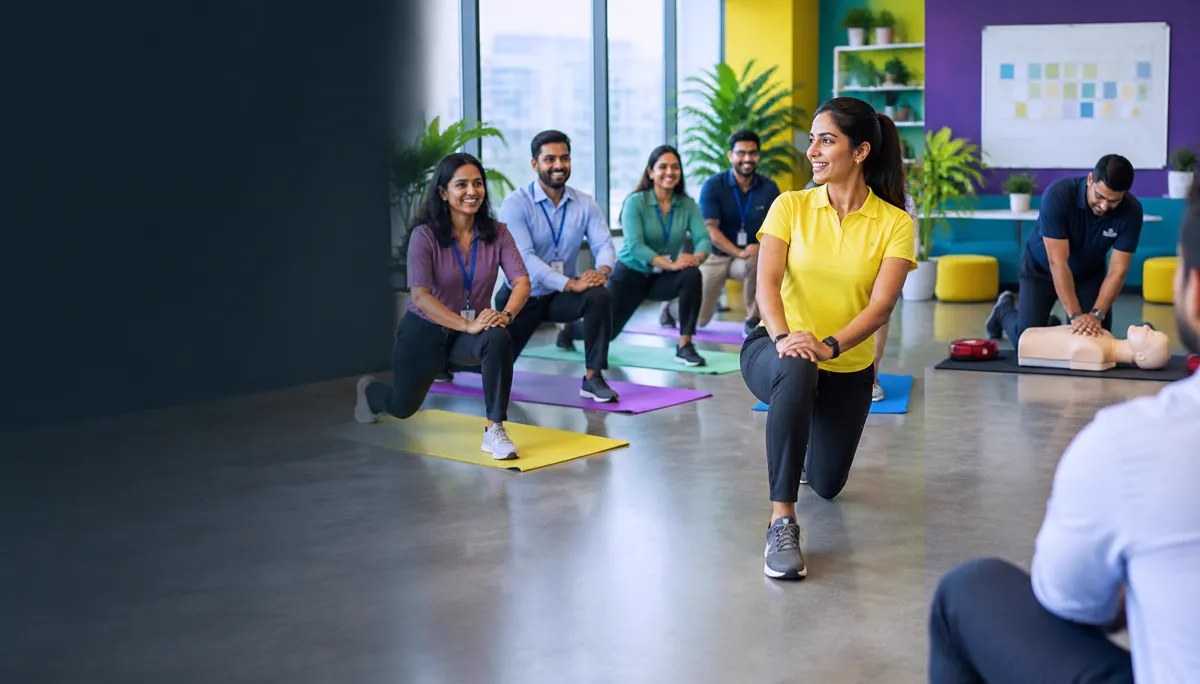
Desk and chair yoga, breathing sessions, International Yoga Day programmes, fitness and movement sessions, and step, water, sleep and weight challenges on our platform.
7. Nutrition
Dietitian-led sessions, personal diet charts based on HRA and checkup results, and canteen guidance — practical for Indian food habits, vegetarian and non-vegetarian, and shift patterns.
8. First aid and safety
First aid, CPR and AED training, first aid box audits, emergency drills and ambulance arrangements — the safety base every wellness programme should sit on.
A 12-month corporate wellness template
The template below follows the year and the national health calendar. Replace any month to suit your business cycle; the point is a steady rhythm, not perfection. Our wellness calendar lists named sessions for each month.
- January: HRA launch and goal setting; new-year nutrition session
- February: cancer awareness (World Cancer Day) and screening information
- March: women's health month around International Women's Day; anaemia awareness
- April: World Health Day theme session; annual checkup camps begin
- May: hypertension awareness and blood pressure screening day
- June: International Yoga Day (21 June) programme; heat-stress talks for site teams
- July: monsoon health — infections, hygiene and food safety
- August: first aid and CPR refreshers; ergonomics and posture
- September: heart health (World Heart Day) and nutrition month
- October: mental health (World Mental Health Day); stress management workshops
- November: diabetes awareness (World Diabetes Day) with sugar screening
- December: year-end review, repeat HRA and plan for next year
Programmes by company size
- Startups and small offices (under about 100 people): HRA, one checkup camp, a session every other month, online sessions for remote staff and trained first aiders
- Mid-size companies (about 100–1,000 people): monthly sessions on a calendar, checkups across cities, periodic onsite doctor visits or a doctor-on-call, stress workshops and challenges
- Large and multi-site employers: a staffed onsite clinic or OHC at major sites, partner-network checkups elsewhere, a central dashboard and site-level champions
Programmes by workforce
- Office teams: posture and desk yoga, screen and eye care, stress and sleep, nutrition for sedentary work, and step challenges
- Factory teams: statutory checkups, hearing and lung health, tobacco cessation, heat and hydration, safety and first aid — sessions run shift by shift in local languages
- Construction sites: BOCW-aligned medicals, heat stress, hygiene at labour camps, first aid and emergency readiness
- Multi-city and field teams: online and hybrid sessions, partner-centre checkups in each city, and a single app for records and consultations
How to evaluate a corporate wellness provider in India
Use the same questions for every provider you speak to, including us. Ask for evidence, not adjectives.
- Services in-house vs partnered: which services the provider delivers with its own team and which through partners — and who is accountable when a partner fails
- City coverage: which cities have onsite teams and which are served by partner centres; how remote employees are covered
- Doctors and nurses: qualifications (MBBS, AFIH where an OHC is required; GNM, ANM or BSc nursing), how they are verified and how leave is covered
- Digital reporting: what employees see, what HR sees, whether reports are anonymised and whether you can export data
- Privacy: how consent is taken, who can access individual data and how it is protected under the DPDP Act
- Languages: whether sessions and materials are available in the languages your workers speak
- Statutory capability: whether the provider can run legally required examinations and keep registers in your state's format
- References: whether you can speak to existing clients with a similar workforce
ROI and what to measure
Return on a wellness programme is real but slow, and claims of a fixed percentage return should be treated with caution — results depend on your workforce, starting risk and how consistently the programme runs. What you can measure reliably is whether the programme reached people and whether risk moved.
- Reach: participation in the HRA, checkups and sessions by location and shift
- Risk: movement of employees between HRA risk bands across rounds
- Follow-up: abnormal results that led to consultation or re-test
- Engagement: session attendance, challenge participation and feedback
- Business indicators HR already tracks — sick leave, claims, attrition — read as signals, not proof
Common reasons programmes fail
- One-off events with nothing in between
- Office-only design that leaves plant, site and field staff out
- No data at the start, so nothing can be measured at the end
- Weak privacy that makes employees avoid the HRA and checkups
- No follow-up of abnormal results
- Sessions in a language or time slot that workers cannot use
Frequently asked questions
What is corporate wellness in India?
A planned, year-round set of services an employer provides — checkups, HRA, onsite care, sessions, mental wellbeing, yoga and fitness, nutrition, and first aid — to keep employees healthy, find risk early and get care quickly.
What should a corporate wellness programme include?
At minimum an HRA, an annual checkup and a calendar of sessions. Complete programmes add onsite care, stress support, yoga and fitness, nutrition and first aid training.
How much does corporate wellness cost in India?
It depends on headcount, cities, workforce type and the components chosen. We publish per-employee checkup prices and quote other services to your scope within one working day.
Can a programme include factory and site workers?
Yes. Sessions run shift by shift in workers' languages, checkups follow statutory requirements and first aid training is built around site hazards.
Do you run sessions online?
Yes — onsite, online or hybrid, so one session can reach every location.
How do we start?
Run an HRA, choose two or three priority risk areas, book checkups and set a 12-month session calendar. Review after 90 days.
How long before we see results?
Participation and engagement show within weeks; risk movement is usually visible between two HRA rounds a year apart.
How do we choose a corporate wellness provider?
Compare providers on in-house vs partnered services, city coverage, doctor and nurse qualifications, digital reporting, privacy, languages, statutory capability and references.
Is corporate wellness the same as health insurance?
No. Insurance pays for treatment after illness; wellness helps prevent illness and find it early. The two work best together.
Can family members be included?
Family health records and family checkup bookings are available on our platform; family coverage in a programme is agreed in the proposal.
Will HR see individual employees' health details?
No. Employees see their own results. HR sees anonymised, aggregated data plus the fitness opinions the law requires for specific roles. Anything more is shared only with the employee's consent, in line with the Digital Personal Data Protection Act, 2023.
What is the difference between this page and the wellness sessions page?
This guide covers the whole corporate wellness programme. The wellness sessions page goes deep on the session library — topics, formats and languages.
Related services
Guides for HR and EHS teams
Cities we serve
Get a quote in 24 hours
Share your headcount and locations — we reply within one working day with a scope and quote.