
OHC services across India
Occupational Health Centre (OHC) in India
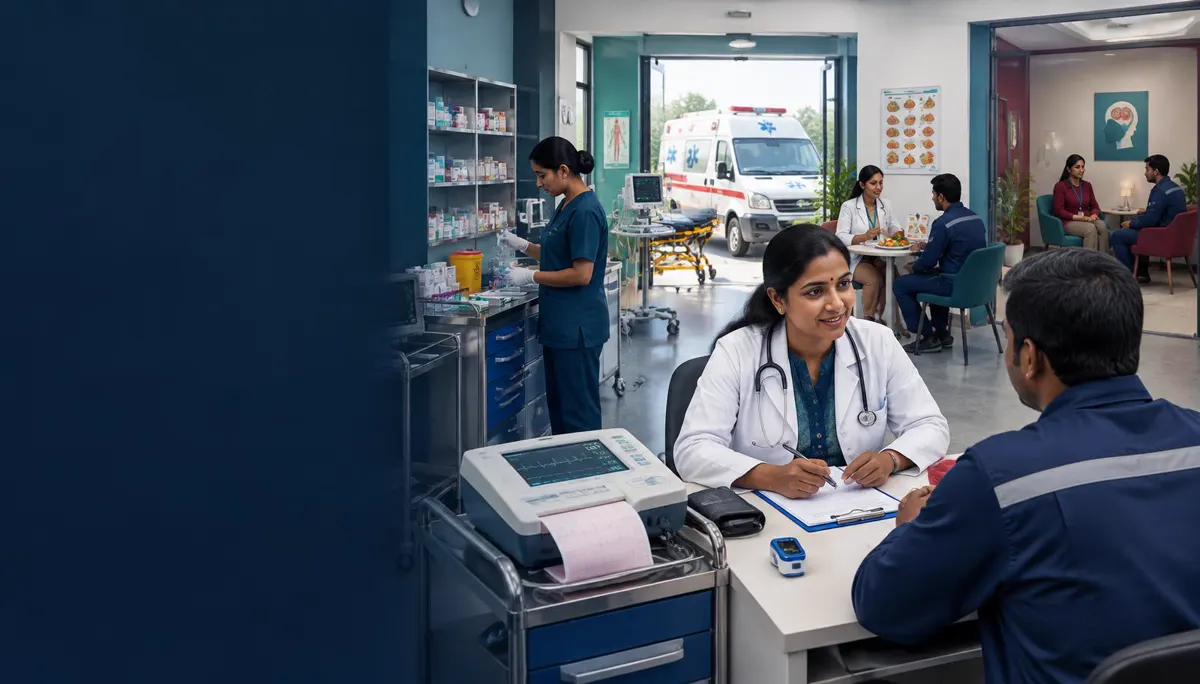
An occupational health centre (OHC) is the medical unit inside a workplace that treats injuries and illness, runs medical examinations for exposed workers, keeps the statutory health records and leads the medical side of the emergency plan. Plan My Health sets up, staffs and runs OHCs for factories, hazardous-process plants, construction projects and large offices across India.
This page is our complete guide to OHC services: who needs one, the legal basis, setup models from a nurse room to a 24x7 centre or a Digital OHC, staffing, equipment, registers, emergency planning, how we set one up and what drives the cost.
About 10 years in corporate health · PAN-India delivery · Trusted by teams at










Available across India, by state
Maharashtra
Delhi, Haryana and Uttar Pradesh
Tamil Nadu
By site type
What an occupational health centre is
An OHC is more than a first aid room. It is a staffed clinical unit with a defined scope: treating injuries and illness at work, examining workers before placement and at intervals, watching for health effects of the work itself, advising management on fitness for duty, and keeping records an inspector or auditor can rely on. In smaller workplaces it may be a single room with a nurse; in large plants it is a small clinic with doctors, nurses, observation beds and a stationed ambulance.
The OHC sits between three groups: employees, who need care and confidentiality; HR, who need fitness opinions and absence information; and EHS, who need injury trends and health surveillance results. A well-run OHC gives each group what it needs without exposing individual medical detail unnecessarily.
Who needs an OHC
- Factories above the headcount at which state rules require an ambulance room or medical facilities
- Plants carrying out hazardous processes, where workers need pre-placement and periodic medical examinations
- Construction and infrastructure projects covered by the BOCW framework, especially large sites with labour camps
- Continuous-process operations — chemicals, pharma, power, steel — where a shift cannot run without medical cover
- Large offices, campuses and 24x7 operations floors that choose an OHC-style medical room for employee wellbeing and emergency readiness
OHC for factories, construction sites and large offices
Factories need the most structured OHC: an ambulance room where the headcount requires it, a medical officer, nurses on every shift, health surveillance for exposed workers and registers in the state's format. The OHC also supports pre-placement checks for new joiners and contract workers, return-to-work reviews and investigation of injuries.
Construction sites need an OHC that moves with the project. It usually starts as a medical post near the main work front and grows as towers, chainages or phases are added. Labour camp health — fevers, diarrhoea, vector-borne illness, sanitation — is often where it prevents the most lost days. Records are tagged by contractor so the principal employer has one site register.
Large offices and campuses rarely have a legal duty to run an OHC, but many choose a nurse-led medical room with a visiting MBBS doctor, BLS-trained floor wardens and AED readiness. The focus is chronic-disease follow-up, quick care for minor illness and being ready for a collapse.
What a day in a well-run OHC looks like
The day starts with a handover from the night nurse and a check of the emergency kit, oxygen and defibrillator. OPD covers minor illness, dressings and follow-ups for diabetic and hypertensive employees; injured workers are seen first. Scheduled medical examinations run in a separate slot so emergencies are never delayed. Every contact is entered in the digital register before the end of the shift, and anything unusual — a cluster of eye injuries in one shop, a worker with a hearing shift — is flagged to EHS the same week.
Health surveillance: linking the OHC to plant hazards
Health surveillance is what turns an OHC from a first aid room into a prevention tool. The medical officer works from the plant's exposure map — noise, dust, fumes, chemicals, heat and night work — to decide which workers need which tests and how often. Results are reviewed as trends by section, not just as individual reports, so engineering controls and PPE can be improved where problems start to appear.
Reporting to HR and EHS
- Monthly OPD and injury summary by department and shift
- Medical examinations due, completed and overdue
- Fitness opinions and job restrictions issued, without medical details
- Emergency calls, ambulance trips and drill results
- Medicine consumption and stock alerts
In-house, outsourced or hybrid OHC
Some companies employ their own medical officer and outsource nursing and ambulance cover; others outsource the entire OHC. Outsourcing helps most where recruitment is hard, shifts are many or relief cover is a recurring problem. We can run all or part of an OHC and work alongside your existing staff.
Nurse room vs onsite clinic vs full OHC vs Digital OHC
These four set-ups are often confused. The table below compares them so you can choose the right level for each site.
- Nurse room — staffed by a qualified nurse (GNM, ANM or BSc); first aid, vitals, dressing and referral; suits smaller offices and low-hazard sites; does not meet OHC requirements where the law requires a doctor
- Onsite clinic — MBBS doctor and nurse for fixed hours; consultations, minor treatment, health records and follow-up; suits large offices and campuses; may or may not satisfy statutory duties depending on site
- Full OHC — AFIH-qualified doctor, nurses, ambulance room or tie-in, statutory registers, pre-employment and periodic examinations, emergency equipment and medicines; required for many hazardous factories
- Digital OHC — virtual doctor consultations, digital registers and digitally signed fitness certificates added to any of the above; statutory tests that need physical examination are still done in person
OHC setup checklist (downloadable PDF)
Our one-page OHC setup checklist covers what to confirm before you open an occupational health centre: the legal basis for your site, staffing and qualifications, the room and layout, equipment and medicines, registers and forms, bio-medical waste, emergency and ambulance arrangements, and digital records. Download it, share it with your EHS team and use it to compare proposals.
OHC services across Indian states
We set up and staff occupational health centres for factories, plants and large sites across India. The state grid below links to our occupational health services pages for each city. State factory rules differ in the forms, registers and examination frequencies they require, so each OHC is set up to the rules of the state where it operates.
How an OHC project runs
- Site visit and gap assessment against the Factories Act, state rules and your processes
- Proposal with staffing, hours, equipment, medicines and registers
- Recruitment and verification of the doctor and nurses, with leave cover
- Room set-up, equipment installation and medicine stock
- Go-live with pre-employment and periodic examinations scheduled
- Monthly reports to EHS and HR, and quarterly reviews
Onsite clinic or OHC: which page is for you?
If your site is a factory or hazardous plant and the law requires occupational health facilities, this OHC page is the right starting point. If you run an office or campus and want a doctor and nurse for convenience and early care, see our onsite clinic page instead — the two services overlap, but the legal duties and staffing differ.
Legal basis for OHCs in India
The Factories Act, 1948 requires first aid appliances in every factory and an ambulance room in factories employing more than 500 workers, with the room, equipment and qualified medical and nursing staff prescribed by state factory rules. Factories carrying out hazardous processes have additional duties, including medical examinations of workers and, in many states, occupational health centre requirements set out in the state rules.
Construction sites fall under the Building and Other Construction Workers Act, 1996 and the BOCW Central Rules and state rules, which cover first aid, transport of injured workers, medical examinations and occupational health services. The Occupational Safety, Health and Working Conditions Code, 2020 consolidates these duties under one code as states notify their rules.
Thresholds, staffing qualifications and equipment lists vary by state and process. Our Mandatory Health Checkup Finder shows state and industry rules, and we confirm what applies to your site before scoping an OHC.
Legal references on this page are general guidance. Exact requirements depend on your state rules, the processes you run and your headcount, so we confirm the applicable rules for each site before we propose a scope.
OHC setup models: from nurse room to 24x7 centre and Digital OHC
- Nurse room: a GNM or BSc nurse during working hours with doctor tele-support — the starting point for smaller sites and offices
- Nurse plus doctor visits: nurses on shift and an MBBS doctor for OPD and fitness checks on fixed days
- Full OHC: medical officer on site, nurses across all shifts, observation beds, ambulance and a health surveillance programme
- 24x7 OHC: round-the-clock doctor and nurse cover for continuous-process plants, with relief staff for every role
- Digital OHC: online consultations and virtual fitness assessments with digitally signed certificates, combined with in-person tests the rules require
Staffing an OHC: MBBS, AFIH and nursing qualifications
Doctors are MBBS with valid state medical council registration. Where state rules or hazardous processes call for a doctor trained in industrial health, we deploy doctors holding the AFIH (Associate Fellow of Industrial Health) qualification. Nurses hold GNM, BSc Nursing or ANM qualifications with nursing council registration, with BLS training and induction into your site's emergency plan.
Staffing is planned shift by shift. We keep a relief pool so leave, weekly offs and resignations never leave a shift without medical cover, and we document handovers between shifts in the digital register.
Equipment and medicines
- Examination couch, screens, wash basin, good lighting and privacy
- BP apparatus, glucometer, pulse oximeter, thermometer, weighing scale with height rod and ECG for larger centres
- Oxygen cylinder with delivery set, suction, AED or defibrillator, stretcher, spine board and splints
- Eye wash and decontamination arrangements where chemicals are handled
- Emergency drug tray and common medicines managed under the doctor's supervision, with expiry tracking
- Colour-coded biomedical waste bins and handover to an authorised operator under the BMW Rules, 2016
Registers and statutory forms
An OHC keeps treatment and injury registers, medicine stock records, referral and ambulance logs, and the health records of medical examinations. Many state rules use a health register (often Form 32 or similar) and a certificate of fitness (often Form 33 or similar); form numbers and formats differ by state. We maintain all of them digitally, in your state's format, and export them for inspections and audits.
Ambulance and the emergency plan
The OHC leads the medical part of the site emergency plan: who responds, how a casualty is moved, which hospitals take which emergencies and how long the route takes at the hours you work. Depending on your site, the plan uses a stationed BLS or ALS ambulance, an on-call arrangement or both. We run drills with your safety team and share a short report of what slowed the response.
How we set up an OHC in 5 steps
- 1. Scoping: headcount by shift, processes, hazards, existing arrangements and the state rules that apply
- 2. Design: setup model, room layout, equipment and medicine list, staffing roster and emergency plan
- 3. Mobilisation: recruitment and verification of doctors and nurses, equipment installation and induction
- 4. Go-live: OPD, injury care, medical examinations and digital registers from day one
- 5. Review: monthly reports to HR and EHS, and a periodic review of staffing and scope as the site changes
What drives the cost of an OHC
The monthly cost of an OHC depends on hours of cover (8, 12 or 24), the number and qualification of doctors and nurses, whether equipment and medicines are bought, rented or supplied by you, ambulance cover, and the volume of medical examinations. We quote each line separately so you can scale up or down; our guide to OHC cost in India explains each driver in detail.
Frequently asked questions
What is an occupational health centre (OHC)?
A staffed medical unit inside a workplace that treats injuries and illness, examines workers, monitors work-related health effects, keeps statutory health records and leads medical emergency response.
Is an OHC mandatory for factories in India?
The Factories Act requires an ambulance room in factories employing more than 500 workers, and state rules add occupational health requirements for hazardous processes. Whether your factory needs a full OHC depends on your state rules, processes and headcount.
What is the difference between an ambulance room and an OHC?
An ambulance room is the medical room and staff the Factories Act requires above a headcount. An OHC is broader: it also runs health surveillance, fitness assessments and emergency planning.
Do you provide AFIH-qualified doctors?
Yes, where state rules or hazardous processes call for a doctor trained in industrial health.
Can you run an OHC on a construction site?
Yes — a site medical room or full site OHC, including labour camp health. See our onsite clinic and OHC for construction sites page.
Can a large office have an OHC?
Offices rarely have a legal duty to run one, but many large campuses choose a nurse-led medical room with a visiting doctor and AED readiness.
What is a Digital OHC?
Online consultations and virtual fitness assessments with digitally signed certificates, used alongside in-person tests that the rules require.
Can you take over an OHC from another provider?
Yes. We plan a handover of staff, stock and records so cover continues without a gap.
How are OHC records kept?
Digitally, in the formats your state prescribes, with exports for inspections and audits.
Will HR see individual employees' medical details?
No. Employees see their own records. HR sees anonymised, aggregated data plus the fitness opinions the law requires for specific roles. Anything more is shared only with the employee's consent, in line with the Digital Personal Data Protection Act, 2023.
What is the difference between an onsite clinic and an OHC?
An onsite clinic is usually a convenience service for offices; an OHC adds statutory duties such as an AFIH-qualified doctor, prescribed examinations, registers and an ambulance room.
Is there a downloadable OHC setup checklist?
Yes — a free one-page PDF linked on this page.
Related services
Guides for HR and EHS teams
Cities we serve
Get a quote in 24 hours
Share your headcount and locations — we reply within one working day with a scope and quote.