
Setting Up an Occupational Health Centre: The Complete India Checklist
Last updated 29 September 2026
OHC manpower, room and equipment requirements, ambulance and medicines, OPD software and statutory registers — what to prepare before the inspector visits.
By the Plan My Health corporate health team
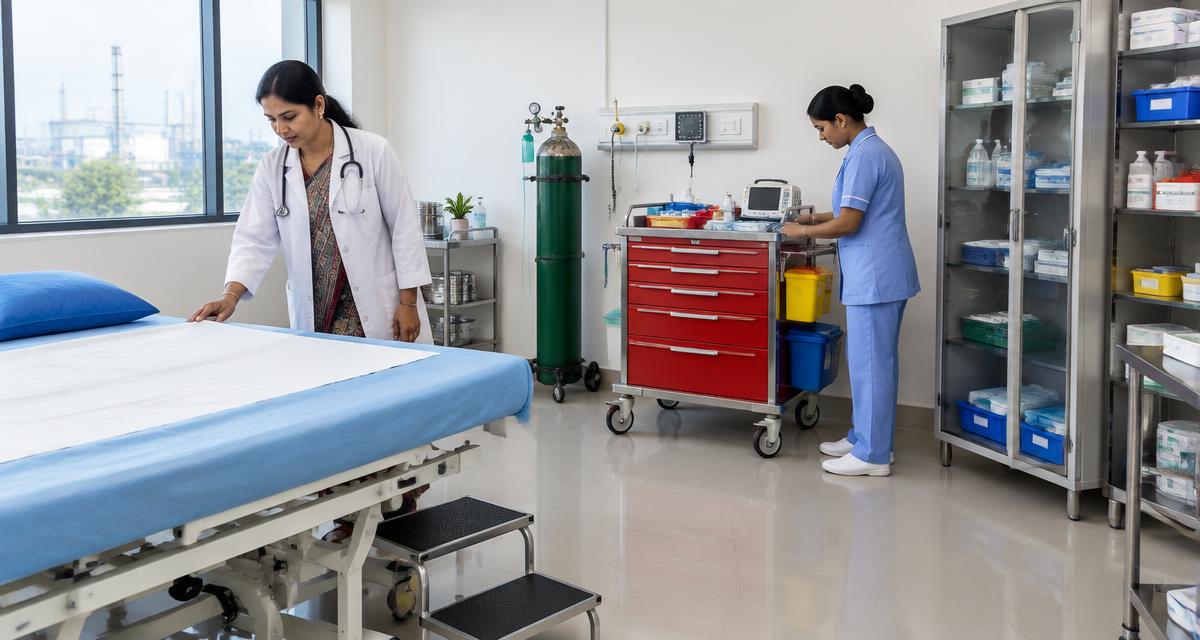
An occupational health centre (OHC) is a statutory requirement for most Indian factories above a modest headcount — and one of the most common audit gaps we see is an OHC that exists on paper but fails on details: no AFIH-qualified doctor of record, expired medicines, no ambulance arrangement, registers that don't match the state format. This checklist covers what a compliant, genuinely useful OHC needs, based on setups we run across plants and infrastructure sites.
Manpower: who must be there
Requirements scale with the number of workers and the hazard category under your state's factory rules — typically one factory medical officer for smaller workforces, escalating to multiple medical officers, nurses and a trained ambulance team for large or hazardous sites. The qualification that matters for the doctor is AFIH (Associate Fellow in Industrial Health), recognised by DGFASLI; a general MBBS without industrial-health training does not satisfy most inspectors for hazardous-process factories. Nurses should have occupational-health orientation, and at least a subset of staff must hold current first-aid certification. Shift coverage is the detail that gets missed: an OHC that is staffed only for the general shift leaves night and weekend shifts uncovered — precisely when incidents tend to happen. When you don't want to hire directly, OHC staffing and management can be taken as a service with rosters, replacements and qualification records handled for you.
Rooms, equipment and medicines
The physical setup follows the state schedule, but a practical baseline includes:
- A treatment room with an examination couch, screen, washbasin and dressing trolley.
- Vitals and diagnostics: BP apparatus, stethoscope, thermometer, pulse oximeter, glucometer, weighing scale, height stand, vision chart (and a Snellen's drum or equivalent where prescribed), ECG machine for larger sites.
- Occupational testing capability or a tie-up: audiometry, spirometry and X-ray through a nearby partner if not onsite.
- An oxygen cylinder with regulator, ambu bag, airway set, and a stretcher.
- Emergency medicines per the scheduled list, with expiry tracking — expired stock is an automatic audit observation.
- An ambulance or a documented, response-time-tested arrangement with a nearby hospital, with the number displayed across the plant.
- Potable drinking water, first-aid boxes per the prescribed ratio (commonly one per 50–150 workers depending on the state) placed and inspected on a schedule.
Records and registers: the part audits are won and lost on
Inspectors ask for the OHC register (daily patient log), the first-aid register, statutory health registers for hazardous-process workers (Form 7 in many states), fitness certificates issued by the certifying surgeon or factory medical officer, medicine and equipment stock records, and ambulance drill or mock-drill records. The registers must match your state's current format, be filled contemporaneously, and reconcile with the health examinations on file. Hand-maintained registers drift; a digital OPD system that generates the statutory register from the same clinical record removes the reconciliation problem entirely.
Software: what an OHC system should actually do
Beyond digitising the OPD log, a good OHC system handles fitness certificates with validity and renewal reminders, medicine and equipment inventory with expiry alerts, employee health records linked to statutory examination schedules, duty rosters for doctors, nurses and ambulances, and MIS reports your EHS head can hand an inspector without a weekend of collation. If you already run OHC automation, the registers and certificates generate themselves; if not, that is the first gap to close even before new equipment purchases.
The 30-day setup sequence
In our experience a compliant OHC goes live in about a month: week one, map the state-rule requirements to your headcount and hazards and finalise the room and equipment list; week two, contract the AFIH doctor and nursing staff and set rosters including night cover; week three, stock medicines and equipment, tie up the ambulance and nearest hospital, and print the register formats; week four, run a mock drill, fill the first weeks of records, and invite your EHS team to walk through an inspector's questions. Then keep the rhythm: monthly medicine checks, quarterly mock drills, annual examination scheduling driven by due dates.
If you are setting up or upgrading an OHC, enrol your company free and our occupational health team will send a setup checklist priced for your site — manpower, equipment, software and statutory registers — within one working day.
Running the centre day to day
Once the centre is open, the quality of daily operations decides whether it is trusted. Keep an OPD register for every visit, a medicine stock register with expiry dates, and a clear escalation path for emergencies, including the nearest hospitals, the ambulance contact and the on-call doctor for every shift. Review stock weekly so that essential emergency medicines never run out.
Staff rotation and training need planning too. Nurses and first-aiders should refresh their emergency skills regularly, and every shift should know who the trained first-aider is. Run mock drills for common emergencies at your site — a fall from height, a chemical splash, a cardiac event — and record what went well and what needs to change.
Use the centre's data. Monthly summaries of visit reasons, injuries, referrals and sick-leave patterns help EHS and HR teams spot problems early, for example a rise in back pain in one department or repeated eye injuries at one workstation. Shared in anonymised form, these reports turn the health centre from a cost line into a source of prevention.
- Keep OPD, stock and emergency registers current every day.
- Train staff and run site-specific emergency drills.
- Share monthly anonymised summaries with EHS and HR.
Plan My Health delivers occupational health centre services, OHC doctor and nurse staffing and OHC medical equipment and medicines for companies across India — talk to our corporate health team for a proposal matched to your workforce.
Share this article
Pick a tagline
The highlighted image above appears automatically as the preview picture on WhatsApp, LinkedIn and Facebook.
Related services
Want this for your workforce?
Start free with 25 employee health risk assessments and a corporate dashboard.
Get started for corporates