
Standby ambulance
Standby Ambulance for Offices, Factories and Construction Sites in India
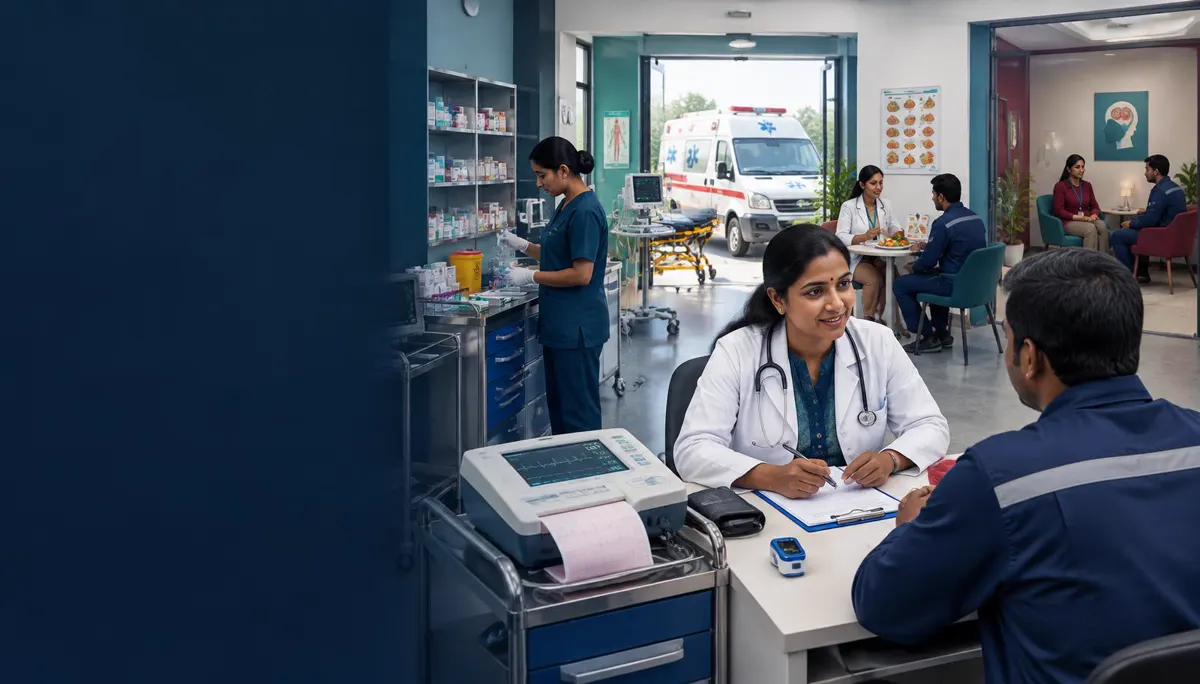
A standby ambulance for a workplace is a BLS or ALS vehicle with a trained driver and paramedic or EMT, either stationed at your site or on call under a written plan, so injured or collapsed employees reach hospital quickly and in a stable condition.
Plan My Health arranges ambulance cover for offices, factories, construction sites and corporate events across India, integrated with your first aiders, onsite clinic and emergency plan.
About 10 years in corporate health · PAN-India delivery · Trusted by teams at







Available in these cities
Maharashtra
Delhi, Haryana and Uttar Pradesh
Tamil Nadu
By site type
BLS and ALS ambulances — the two types we station
- BLS ambulance (Basic Life Support) — the standard factory ambulance: stretcher, oxygen cylinder, first-aid and trauma kit, BP apparatus, pulse oximeter, splints and a trained driver-EMT. Right for most sites within quick reach of a hospital.
- ALS ambulance (Advanced Life Support) — adds a cardiac monitor and defibrillator, suction machine, advanced airway kit, IV fluids and emergency medicines, crewed by a paramedic or nurse with a doctor on tele-support. Recommended for hazardous-process plants, remote sites and large headcounts.
- Patient transport vehicle — for non-emergency transfers such as taking an injured worker for an X-ray, where a full ambulance is not needed
- Ambulance with driver and EMT by shift, including 24x7 cover for continuous-process plants
Stationed ambulance, on-call cover or event standby
- Stationed on site by shift — for factories, hazardous plants and large projects
- On-call with an agreed response plan — for most offices and smaller sites
- Event standby — for town halls, sports days, marathons and offsites
Crew: driver plus paramedic or EMT
Every ambulance is crewed by a trained driver and a paramedic or EMT, inducted into your site rules. ALS cover can add a nurse, with doctor tele-support.
Response planning and nearest-hospital mapping
We time the route from your gate to the nearest suitable hospitals for trauma, burns and cardiac emergencies at the hours you work, mark ambulance parking and stretcher routes, and review the plan whenever the site layout changes.
What the ambulance service includes
- Equipment and consumables checklist verified every shift
- Referral tie-ups with nearby hospitals and trauma centres, with the route mapped in advance
- Response time logging and monthly reports to your EHS head
- Joint emergency and evacuation drills with your safety team, with a scored report
Ambulance room and ambulance requirements under factory rules
The Factories Act and state rules require an ambulance room above prescribed headcounts, and some states and processes also call for an ambulance van. Requirements differ by state and process.
Legal references on this page are general guidance. Exact requirements depend on your state factory rules, the processes you run and your headcount, so we confirm the applicable rules for each site before we propose a scope.
How we work with your HR and EHS team
Every engagement starts with a short scoping call and, for plants, a site walk-through. We map headcount by shift, the processes and hazards on site, the statutory registers you already keep and the gaps an inspector or auditor is likely to find. You then receive a written proposal with scope, staffing, timelines and a per-employee or monthly price — no bundled extras you did not ask for.
- Scoping call and site or office assessment
- Written proposal with scope, deliverables and pricing
- Mobilisation of doctors, nurses, technicians or trainers
- Delivery with digital records in the Plan My Health platform
- Monthly or quarterly review with HR, EHS and plant leadership
Frequently asked questions
Can the ambulance be shared across nearby sites?
Sometimes, if response times remain safe. We assess distances and shifts before proposing a shared model.
Is the ambulance available 24x7?
We staff it to match your shift pattern, including round-the-clock cover.
Do you run emergency drills?
Yes, we run joint drills and share a scored report.
Do offices need an ambulance?
Usually an on-call plan plus trained floor wardens is enough, with standby cover for events. See ambulance for corporate offices.
What is the difference between BLS and ALS?
BLS covers basic life support with oxygen, trauma kit and a trained crew; ALS adds cardiac monitoring, defibrillation, advanced airway and emergency drugs.
Related services
Guides for HR and EHS teams
Cities we serve
Get a quote in 24 hours
Share your headcount and locations — we reply within one working day with a scope and quote.