
A 12-Minute Desk Yoga Routine for Office Employees (With Safety Notes)
Last updated 11 October 2026
This 12-minute desk yoga routine eases neck, shoulder, back and wrist stiffness and can be done in work clothes at your workstation. Follow the steps, respect the safety notes and stop if anything hurts.
By the Plan My Health corporate health team
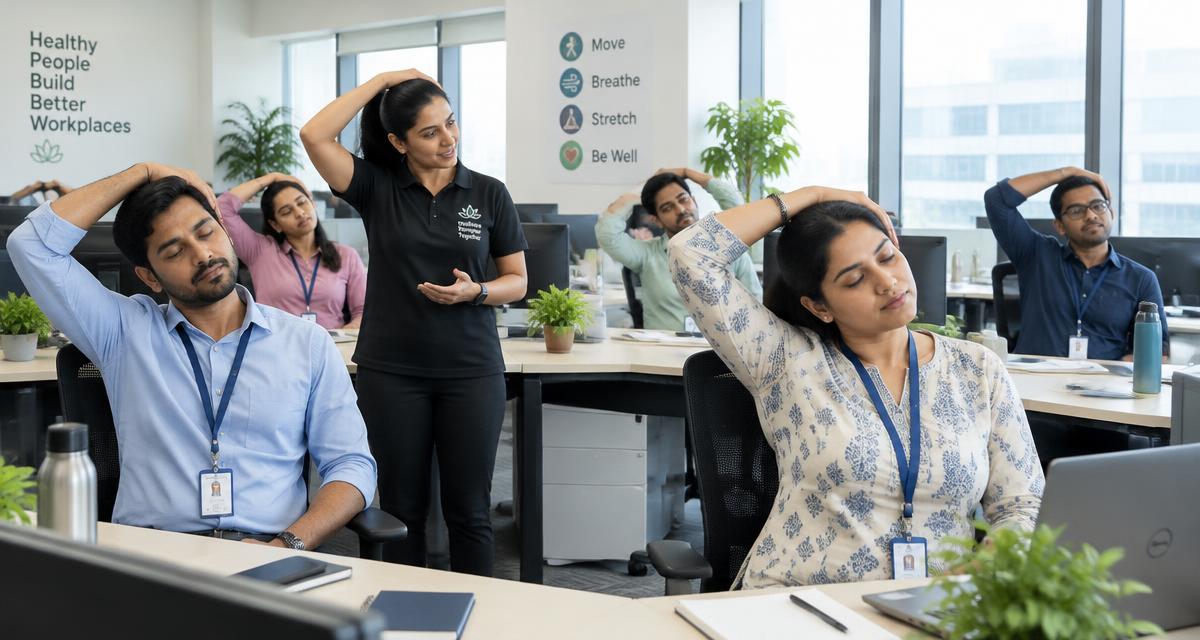
A desk yoga routine is a short sequence of gentle stretches and breathing you can do at your workstation, in work clothes, to ease the stiffness that builds up after hours of sitting. The 12-minute routine below covers the neck, shoulders, upper and lower back, hips, wrists and eyes, and finishes with a calming breath. Read the safety notes first, move slowly and stop if anything hurts. It is the same kind of routine our instructors teach in corporate yoga sessions for offices in India.
Safety notes before you start
- Move slowly and within a comfortable range. Stretching should feel like mild tension, never pain.
- Breathe normally throughout; do not hold your breath.
- If you have a neck or back problem, recent surgery, are pregnant, have high blood pressure, glaucoma, dizziness or any condition your doctor has advised caution on, check with your doctor first and skip any movement that does not feel right.
- Use a stable chair without wheels if possible, or lock the wheels. Sit towards the front of the seat with feet flat on the floor.
- Stop immediately if you feel pain, numbness, tingling, chest discomfort, breathlessness or dizziness.
This routine supports comfort and wellbeing. It is not a treatment for any medical condition; persistent pain should be assessed by a doctor or physiotherapist.
Minute 0–1: Settle and breathe
Sit tall, feet flat, hands resting on your thighs. Close your eyes or lower your gaze. Breathe in slowly through the nose for a count of four and out for a count of six. Repeat five or six times. Let your shoulders drop away from your ears on each exhale.
Minute 1–2: Neck side stretch
Sitting tall, gently lower your right ear towards your right shoulder without lifting the shoulder. Hold for three slow breaths. Return to centre and repeat on the left. Do each side twice. Do not roll the head in full circles; keep the movement simple and controlled.
Minute 2–3: Chin tucks
Looking straight ahead, gently draw your chin straight back, as if making a double chin, then release. Repeat eight to ten times. This counters the forward-head posture that develops when we lean towards a screen.
Minute 3–4: Shoulder rolls and shrugs
Lift both shoulders towards your ears as you breathe in, then roll them back and down as you breathe out. Repeat eight times. Then reverse the direction four times.
Minute 4–5: Seated cat-cow
Place hands on your knees. As you breathe in, gently arch your back and lift your chest, looking slightly upward. As you breathe out, round your back, draw your belly in and let your chin drop. Move slowly between the two positions six to eight times. Keep the movement small if your back is stiff.
Minute 5–6: Seated side stretch
Raise your right arm overhead, keep your left hand on the seat and lean gently to the left. Hold for three breaths, feeling the stretch along the right side. Return and switch sides. Repeat twice on each side.
Minute 6–7: Seated twist
Sit tall. Place your left hand on your right knee and your right hand on the back of the chair or the seat behind you. Breathing in, lengthen your spine; breathing out, turn gently to the right. Hold for three breaths, return and repeat to the left. Twist from the middle of the back, not by pulling hard with the arms. Skip this if you have a back problem your doctor has asked you to protect.
Minute 7–8: Seated hip and glute stretch
Place your right ankle on your left knee if that is comfortable; otherwise simply cross the legs at the ankles. Sit tall and lean forward a little from the hips until you feel a stretch in the right hip. Hold for three to five breaths. Switch sides. This helps hips that tighten after long sitting.
Minute 8–9: Wrist and finger care
Extend your right arm in front of you, palm up. With your left hand, gently draw the fingers down and back for three breaths. Turn the palm down and gently press the back of the hand for three breaths. Switch arms. Then make fists and spread the fingers wide ten times. Useful for anyone who types or uses a mouse all day.
Minute 9–10: Ankle circles and calf pumps
Lift one foot slightly and circle the ankle five times in each direction. Switch feet. Then, with both feet on the floor, lift your heels and lower them ten times. This helps circulation in the legs during long periods of sitting.
Minute 10–11: Eye relaxation
Rub your palms together until warm and rest them gently over closed eyes for a few breaths. Then look away from the screen at something at least six metres away for twenty seconds. Blink slowly a few times. Repeat once more.
Minute 11–12: Closing breath
Return to the settled seated position. Breathe in for four and out for six, five or six times. Notice how your neck, shoulders and back feel compared with the start. Open your eyes and return to work slowly.
How often to do it
Once or twice a day works for most people — mid-morning and mid-afternoon are good times. Between full routines, take a short micro-break every 30 to 45 minutes: stand up, roll your shoulders and look away from the screen. A short routine done regularly does more than a long one done rarely.
Making it a team habit
Desk yoga is easier to keep up as a group. Some teams start their daily huddle with three minutes of stretching; others set a shared calendar reminder at 11 am and 3:30 pm. A short guided session — in the office or over video — once a week helps people learn the movements correctly. International Yoga Day on 21 June is a natural moment to launch it company-wide.
Pair it with your workstation
Stretching helps, but so does the set-up you return to: screen at or slightly below eye level, an arm's length away; elbows close to the body at roughly a right angle; feet supported; and a chair that supports the lower back. A physiotherapist-led ergonomics session makes a good companion to a desk yoga programme, and both feature in corporate fitness programs in India.
Adapting the routine for factory and standing roles
Workers who stand or lift all day need a slightly different routine: standing shoulder and neck releases, gentle back extensions, calf and hamstring stretches, and wrist care for repetitive work. These are done standing, in work clothes and without mats, ideally at the start of a shift. Our instructors adapt the routine for plant floors and warehouses.
How Plan My Health helps
We run corporate yoga and desk yoga sessions onsite and online across India, led by certified instructors, with a short health questionnaire before programmes start. They sit within our wider wellness sessions for employees, so desk yoga can be combined with ergonomics, stress management and fitness challenges.
FAQs
Can I do desk yoga in office clothes?
Yes. Every movement in this routine can be done seated or standing at your desk in normal work clothes.
How often should I do desk yoga?
Once or twice a day, with short micro-breaks every 30 to 45 minutes in between.
Is desk yoga safe if I have back pain?
Check with your doctor or physiotherapist first, move gently and skip any movement that causes pain.
Will desk yoga cure neck or back pain?
No routine can promise that. Desk yoga can ease stiffness; persistent pain should be assessed by a professional.
Can my company run guided desk yoga sessions?
Yes — guided onsite or online sessions help teams learn the movements correctly and keep the habit.
Share this article
Pick a tagline
The highlighted image above appears automatically as the preview picture on WhatsApp, LinkedIn and Facebook.
Related services
Want this for your workforce?
Start free with 25 employee health risk assessments and a corporate dashboard.
Get started for corporates