
AED in the Office: A Practical Guide for Indian Workplaces
Last updated 11 October 2026
An AED helps a colleague in cardiac arrest only if it can be reached in minutes and someone nearby is trained to use it. This guide covers how AEDs work, where to place them, how to maintain them and who to train.
By the Plan My Health corporate health team
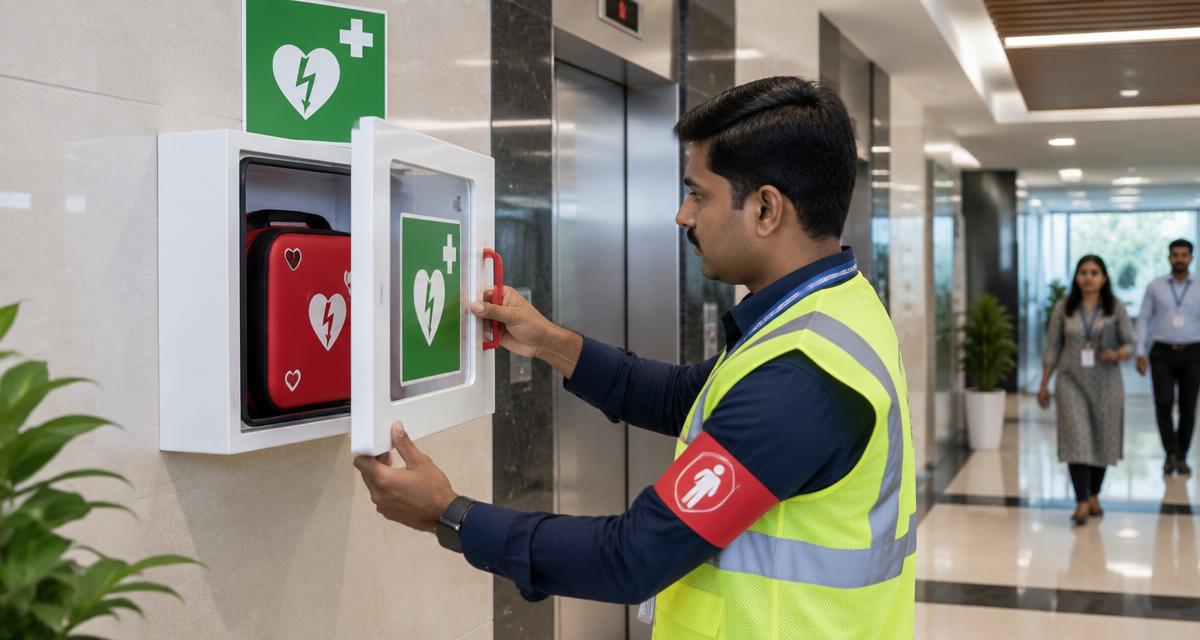
An AED (automated external defibrillator) in the office can help save a colleague in sudden cardiac arrest, but only if three things are true: it can be reached and brought back within a few minutes from anywhere in the building, it is maintained and ready, and people nearby are trained to start CPR and use it without hesitation. This guide covers how AEDs work, where to put them, how to look after them and who to train. For how many people to train in CPR, see our companion article on CPR training at work.
What an AED does
In many cases of sudden cardiac arrest, the heart's electrical rhythm becomes chaotic and it stops pumping blood effectively. An AED analyses the rhythm through pads placed on the chest and, if a shockable rhythm is detected, delivers a shock to try to restore a normal rhythm. CPR keeps some blood flowing to the brain until that happens, so CPR and AED use go together.
AEDs are designed for use by non-medical people. Once switched on, they give clear voice prompts: where to place the pads, when to stand clear and whether to press the shock button or continue CPR. They will not deliver a shock unless the rhythm calls for one.
Why minutes matter
Every minute without CPR and defibrillation reduces the chance of survival. In a large office building, the time it takes for an ambulance to arrive, reach the right floor and get to the casualty can be long, especially at peak traffic hours. An AED on the same floor, with trained colleagues, closes that gap. This is why AED placement is about walking time, not just having one device somewhere in the building.
Where to place AEDs
- Walking time first: place AEDs so a trained person can fetch one and return to any point on the floor within a few minutes. In large or multi-floor offices, that usually means more than one.
- Visible, central locations: near lift lobbies, reception, cafeterias, gyms and large meeting or training rooms.
- Unlocked access: in a wall cabinet with clear signage, not inside a locked office or a drawer. A cabinet alarm can deter misuse without delaying access.
- Mapped and signed: mark AED locations on floor plans, evacuation maps and the emergency plan, and include them in induction.
- Shared buildings: in multi-tenant buildings, coordinate with building management so you know where the building's own AEDs are and who can access them out of hours.
For factories and campuses, consider control rooms, canteens, the OHC or medical room and high-occupancy areas, and how long it takes to reach the farthest work area.
Choosing an AED
Most workplace AEDs are fully or semi-automatic. Points to consider when buying include clear voice prompts in the languages your staff use, simple pad placement diagrams, availability of adult and paediatric pads if children may be present (for example at family events), battery and pad shelf life, local service support and the availability of training units. Your OHC doctor or medical provider can advise on suitability for your site.
Maintenance: keeping the AED ready
An AED that fails when needed is worse than none, because people rely on it. Set up a simple routine:
- Weekly or monthly visual check: the status indicator shows ready, the cabinet is accessible, pads and a pair of gloves, scissors and a razor are with the device.
- Expiry tracking: pads and batteries have expiry dates. Record them and replace them before they lapse.
- After every use: replace pads, check the battery and restock accessories.
- Named owner: one person — often the OHC nurse, admin or security lead — is responsible, with a backup.
- Inspection tag: a tag on the cabinet with the last check date and initials.
Who to train
Anyone can use an AED, but trained people act faster. Prioritise floor wardens and fire marshals, security and reception staff, OHC and admin teams, and volunteers on every floor and shift. Training should include CPR, AED use with a training unit, choking and a simple team plan: one person starts CPR, one fetches the AED, one calls the ambulance, one meets the ambulance at the gate and holds the lift. Our CPR and AED training for employees covers all of this in hands-on sessions.
Building the AED into your emergency plan
The AED is one link in a chain. Your emergency plan should state who calls the ambulance and which number, who informs the OHC or first aiders, how security guides the ambulance in, how the lift is held, and which hospital is nearest for cardiac emergencies at different times of day. Our guide to a standby ambulance for office and factory covers the ambulance side.
Running a drill
A short drill a few weeks after training tests the real system: how long it takes to notice the collapse, get the AED to the casualty and make the ambulance call. Drills often reveal practical problems — a cabinet blocked by furniture, a locked floor, a security guard unsure of the procedure. Fix them and drill again.
AEDs at events and offsites
Company events, sports days and offsites bring large groups together, often away from the usual building. Check whether the venue has an AED and where it is, or arrange for one to be on site with trained staff, and brief the event team on the emergency plan.
Common mistakes
- Buying one AED for a large building and placing it in a locked room.
- Not training anyone, on the assumption the device is self-explanatory.
- Letting pads and batteries expire.
- Not telling employees where the AED is.
- Leaving the AED out of the emergency plan and drills.
AEDs and prevention
AED readiness responds to an emergency; prevention reduces the chance of one. Health risk assessments, checkups that include BP, sugar and lipids, and heart-health sessions help employees understand and lower their risk. Together with CPR training, they form a complete heart-safety plan.
How Plan My Health helps
We run hands-on CPR and AED training for employees and broader first aid and CPR training at offices, factories and sites across India, help you plan AED locations and drills, and can provide an onsite clinic with doctor and nurse to own your emergency equipment.
FAQs
Can untrained people use an AED?
Yes, AEDs give voice prompts and only shock when needed, but trained people act faster and more confidently.
How many AEDs does an office need?
Enough that a trained person can fetch one and reach any point within a few minutes — often more than one in large or multi-floor offices.
Where should an AED be placed?
In an unlocked, signed cabinet in a central location such as a lift lobby, reception or cafeteria, marked on floor plans.
How do we maintain an AED?
Regular visual checks, tracking pad and battery expiry, restocking after use and a named owner.
Who should be trained to use the AED?
Floor wardens, security, reception, OHC and admin staff, and volunteers on every floor and shift.
Share this article
Pick a tagline
The highlighted image above appears automatically as the preview picture on WhatsApp, LinkedIn and Facebook.
Related services
Want this for your workforce?
Start free with 25 employee health risk assessments and a corporate dashboard.
Get started for corporates