
Your Employee HRA Report Is In: What HR Should Do Next
Last updated 11 October 2026
Once the aggregate HRA report arrives, HR should check participation, pick the two or three biggest risk areas, match each to a specific action and set a date to re-measure. Here is a step-by-step way to turn the report into a 90-day plan.
By the Plan My Health corporate health team
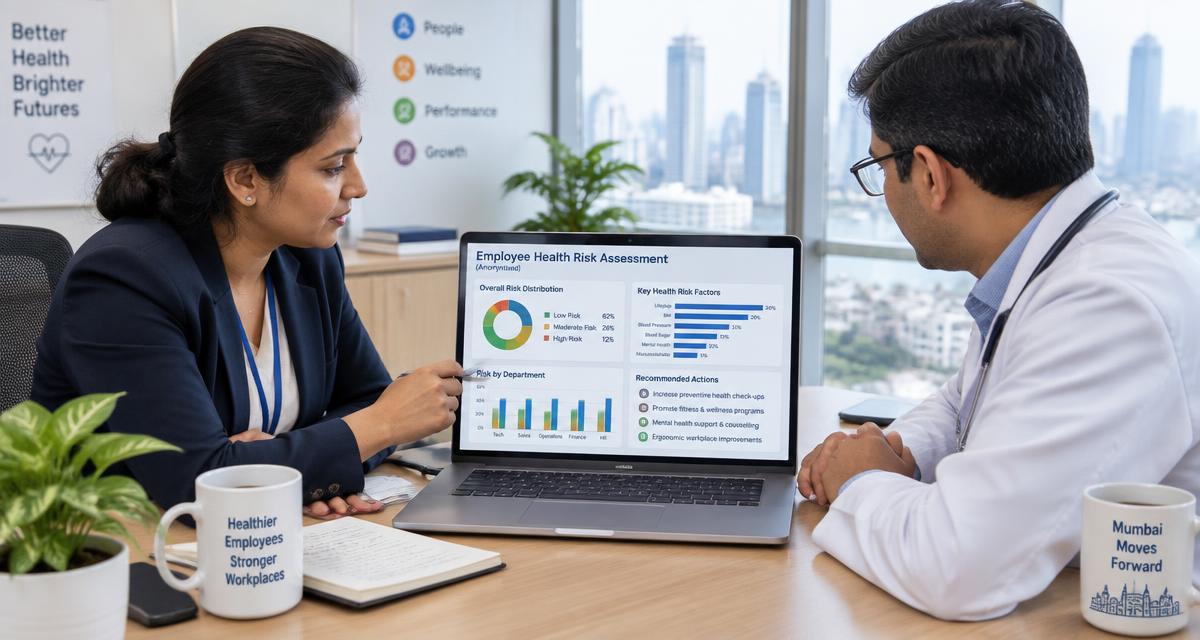
When your employee health risk assessment (HRA) report arrives, the most useful thing HR can do is resist trying to fix everything. Check whether participation is high enough to trust the picture, pick the two or three risk areas that affect the most people, match each one to a specific action with an owner and a date, and plan when you will measure again. This guide walks through each step, using the kind of anonymised report our employee health risk assessment in India produces.
If you have not yet run an assessment, start with why every employer needs a health risk assessment. This article assumes the report is already in your inbox.
Step 1: Check participation before reading anything else
An HRA report describes the people who took it, not the whole company. If only the most health-conscious employees took part, the report will look better than reality. Look at participation by location, department, shift and age band. Where a group's participation is low, treat its results as a hint, not a finding, and plan a second push — an assisted session at a checkup camp, a reminder from that team's manager or a help desk in the canteen for workers without email.
Also check that small groups are suppressed. A report that shows results for a team of four is not anonymous, and employees will notice. If you see very small groups, ask for them to be merged before the report is shared more widely.
Step 2: Read the risk distribution, not just the average score
An average risk score hides more than it shows. Two locations with the same average can look very different: one with most people in the moderate band, another split between low risk and a worrying high-risk group. Look at how many employees sit in the low, moderate and high bands, and how that differs by group. The high-risk group is where follow-up matters most; the moderate group is where prevention gives the best return, because many of those risks are still reversible.
Step 3: Find the top two or three risk factors
Most reports rank the contributing factors — for example low physical activity, long sitting hours, poor sleep, high stress, tobacco use, raised BMI on Indian cut-offs, or blood pressure and sugar values where employees entered them. Pick the two or three that affect the largest share of employees, plus any factor that is less common but serious, such as uncontrolled blood pressure in a shift-working group. Write them down in plain language: 'about half of our office staff report sitting more than eight hours a day' is easier to act on than a chart.
Step 4: Match each risk to an action
Each risk factor should lead to one or two actions that are specific, scheduled and owned. A simple matching table helps:
| Risk area in the report | Practical action |
|---|---|
| Low activity, long sitting | Desk-yoga breaks, a team step challenge, ergonomics session |
| High stress, poor sleep | Stress management workshop, sleep session, manager training, counselling access |
| Raised BMI or sugar risk | Targeted checkup, nutrition session, diet plans |
| Blood pressure risk | BP screening day, doctor consultations, heart-health talk |
| Tobacco use | Quit clinic in the workers' language, follow-up consultations |
Our wellness sessions for employees in India cover every row of this table, and the corporate health checkup packages can be chosen to confirm the risks the HRA has flagged.
Step 5: Prioritise follow-up for the high-risk group
HR should not know who is in the high-risk group, and should not try to find out. Instead, the platform prompts those employees directly — with a suggested consultation, a checkup or a re-test — and HR sees only how many followed up. Your job is to remove barriers: make consultations free or low-cost, allow time off for tests, and remind everyone that results are confidential.
Step 6: Build a 90-day plan
Turn the actions into a short calendar. A typical 90-day plan after an HRA looks like this:
- Weeks 1–2: share a short, anonymised summary with employees and announce what the company will do about it.
- Weeks 3–4: run the first targeted session — for example a stress management workshop or a nutrition session — and open consultations for those who want them.
- Weeks 5–8: launch a team challenge on the platform, hold a screening day for BP and sugar, run a manager session if stress was high.
- Weeks 9–12: a second session on the top risk area, a reminder to complete follow-ups and a check of participation numbers.
Keep the plan small enough to deliver. Three things done well beat ten announced and forgotten.
Step 7: Share results with employees
Employees took the assessment; they deserve to hear what it found and what will change. A short message with two or three headline findings, framed positively and anonymously, and a list of what the company is doing next builds trust for the next round. Avoid anything that could identify a small team, and never single out a department as 'unhealthy'.
Step 8: Share results with leadership
Leadership needs a one-page view: participation, the top risks, the actions planned, the budget and the date of the next measurement. Where your broker or insurer is involved, aggregated data and a record of interventions can support renewal discussions — our guide to HRA for insurers and brokers explains how to share it without exposing anyone's data. Do not promise premium reductions; promise a clearer picture and a plan.
Step 9: Re-measure at the right time
Plan the next HRA before the first plan starts. Six months is a good interval if you are running an active programme; twelve months if you are aligning it with the annual checkup. Compare the same groups, and look at the share of employees moving between bands rather than small changes in the average. Track participation in each action alongside, so you can see which actions people actually used.
Reading the report for factory and site teams
Factory and construction workforces often show different patterns from offices: more tobacco, higher blood pressure, less sleep on rotating shifts and less sitting. Their actions also look different — toolbox health talks at shift start, quit clinics, BP screening during the factory medical checkup and nutrition advice for night shifts. Read their results separately rather than blending them with office staff.
Common mistakes after an HRA
- Sharing the full report widely before checking that small groups are suppressed.
- Launching a generic wellness calendar that ignores what the report found.
- Treating the HRA as a one-off survey with no repeat date.
- Asking managers to 'follow up' with individuals, which breaks the privacy promise.
- Measuring success only by the average score instead of movement between risk bands.
A note on Indian BMI cut-offs
If your report shows more employees at raised weight risk than you expected, that may be because it uses Asian-Indian BMI cut-offs, which flag risk at a lower BMI than Western bands. That is deliberate: South Asians tend to develop diabetes and heart disease at lower body weights. Read more in why Indian BMI cut-offs matter.
How Plan My Health helps
Our employee health risk assessment gives every employee a personal report and 90-day plan, and gives HR an anonymised report with recommended actions. We then deliver the sessions, checkups and consultations those actions call for, and run the repeat assessment so you can see what changed. Companies can start free with their first 25 employees — part of a wider plan of employee health benefits in India.
FAQs
What should HR do first with an HRA report?
Check participation by group, then read the risk distribution and pick the two or three risk factors that affect the most employees.
Can HR see which employees are high risk?
No. High-risk employees are prompted directly by the platform; HR sees only anonymised counts and follow-up rates.
How soon should we repeat the HRA?
Six months if you run an active programme, twelve months if aligned with the annual checkup.
What if participation was low?
Treat the results as indicative and run a second push with assisted sessions, manager reminders and a clear privacy message.
Should we share HRA results with employees?
Yes, as a short anonymised summary with what the company will do next. It builds trust for the next round.
Share this article
Pick a tagline
The highlighted image above appears automatically as the preview picture on WhatsApp, LinkedIn and Facebook.
Related services
Want this for your workforce?
Start free with 25 employee health risk assessments and a corporate dashboard.
Get started for corporates