
Factory worker health surveillance: a practical guide for Indian manufacturers
How Indian manufacturers can set up health surveillance that links workplace hazards to the right tests, catches early change and keeps records inspection-ready.
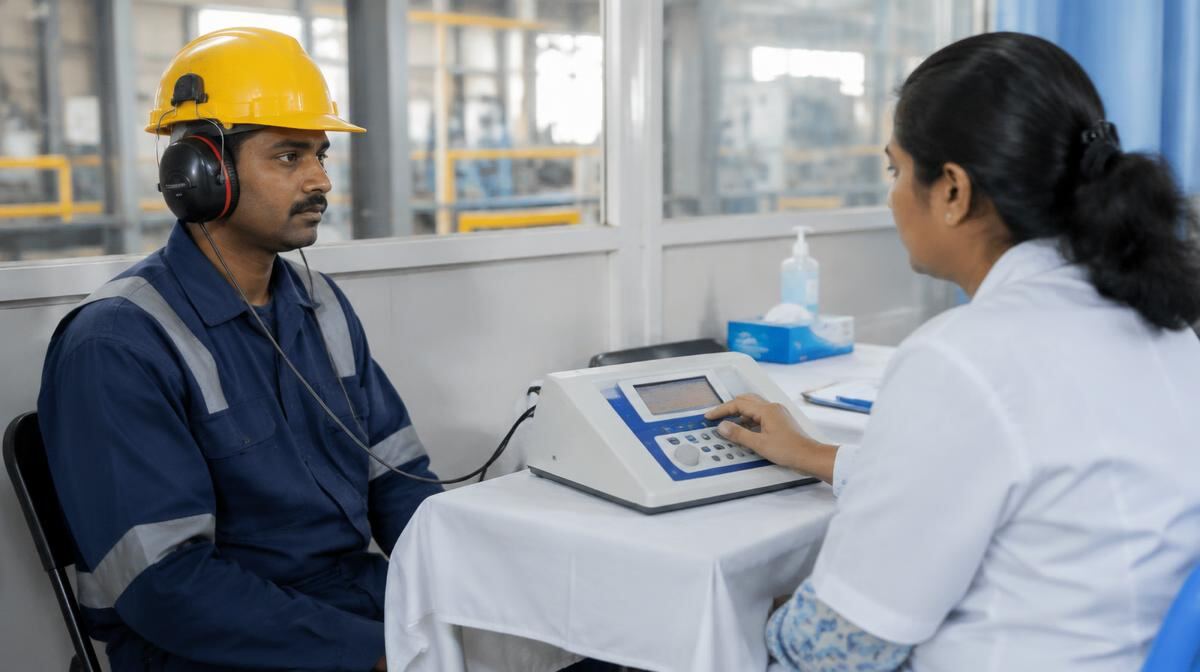
Health surveillance means checking workers' health regularly, in a planned way, because of the specific hazards they are exposed to at work. It is different from a general annual checkup. The aim is to find early signs of work-related ill health — such as noise-induced hearing loss, reduced lung function or skin problems — while they can still be prevented from getting worse.
For Indian manufacturers, surveillance also supports legal compliance, customer audits and better decisions about controls on the shop floor. This guide sets out a practical approach. For onsite delivery, see our workers' health checkup for factories service.
Step 1: start with your hazard register
Surveillance should follow hazards, not habit. Work with your EHS team to list the hazards in each area and the roles exposed to them:
- Noise from presses, compressors, grinding and fabrication
- Dust and fumes from welding, foundry work, cement, textiles or chemical handling
- Chemicals that can affect skin, lungs, liver, kidneys or blood
- Vibration from hand tools
- Heat from furnaces, kilns and poorly ventilated sheds
- Manual handling and repetitive work
- Visual demands in inspection and precision work
Step 2: match each hazard to the right tests
A qualified occupational health doctor should decide the final list, but common matches include:
- Noise: audiometry
- Dust and fumes: lung function tests (spirometry) and chest X-ray where clinically indicated
- Chemicals: tests chosen for the specific substance, such as liver or kidney function or blood counts, plus skin examination
- Heat: blood pressure, hydration-related checks and fitness review
- Visual tasks and driving: vision and colour vision
- Manual handling: musculoskeletal examination
Where your state notifies a process as hazardous, the rules may specify examinations and intervals. Consult the applicable state rules.
Step 3: set the baseline and the interval
The pre-employment or pre-placement examination is the baseline. Periodic surveillance repeats the relevant tests at intervals set by the rules, the level of exposure and medical advice. Workers moving into a new exposed role should get a fresh baseline for that hazard. Our article on pre-employment vs periodic medical checkups explains the difference in more detail.
Step 4: run camps without stopping production
Plan by shift and department
Schedule stations near the shop floor and rotate departments through by shift. Agree the plan with production heads in advance.
Use consistent equipment and methods
Results are only comparable if tests are done the same way each time — for example, audiometry in a quiet enough space with calibrated equipment.
Include contract and temporary workers
They often do the most exposed work and are the easiest to miss.
Step 5: act on the results
Surveillance only works when results lead to action:
- For the individual: doctor review, advice, referral where needed and a retest date
- For the workplace: when several workers in one area show the same change, investigate controls such as enclosures, ventilation, PPE fit and rotation
- For fitness: record any restrictions clearly and review them on schedule
Share aggregated trends with EHS and management; keep individual medical details confidential.
Step 6: keep records inspection-ready
Keep examination records, fitness certificates and registers in the format your state rules require, for the period they require. Digital records make it far easier to show an inspector or customer auditor exactly who was examined, when and with what result. A digital occupational health centre can help.
Who does what in a surveillance programme
- EHS team: maintains the hazard register, exposure data and controls
- Occupational health doctor: sets the test list, reviews every result and issues fitness opinions
- Nurses and technicians: run tests consistently and flag urgent findings on the day
- HR and plant management: release workers for camps, act on restrictions and fund control improvements
- Workers: attend, report symptoms early and use protective equipment correctly
Agreeing these roles in writing before the first camp avoids the most common failure: results that everyone assumes someone else will act on. A short quarterly review between the doctor, EHS and HR keeps the programme on track and turns individual results into better controls on the shop floor.
Common pitfalls
- One generic panel for everyone, regardless of exposure
- Tests done but never reviewed by a doctor
- No link between results and shop-floor controls
- Records split across vendors, PDFs and paper files
For test-by-hazard detail, read factory medical checkup tests by hazard. If your site also needs an OHC, see our OHC setup services.
Plan My Health runs hazard-based surveillance camps at plants across India. Request a proposal with your hazard list and headcount.
FAQs
Is health surveillance the same as an annual checkup?
No. Surveillance is linked to specific workplace hazards and repeats targeted tests; an annual checkup focuses on general health.
Who should be included?
Every worker exposed to the relevant hazards, including contract and temporary workers.
How often should surveillance be done?
It depends on the hazard, exposure level and state rules. Consult the applicable state rules and your occupational health doctor.
What happens if a worker shows early hearing loss?
A doctor reviews the result, advises the worker and sets a retest, and the site reviews noise controls and hearing protection.
Share this article
Pick a tagline
The highlighted image above appears automatically as the preview picture on WhatsApp, LinkedIn and Facebook.
Related services
Want this for your workforce?
Start free with 25 employee health risk assessments and a corporate dashboard.
Get started for corporates