
Corporate Health Checkup Packages: Buyer's Guide 2026
Last updated 29 September 2026
What to include in an employee checkup programme, what it should cost, onsite camp vs lab visits, and how to compare vendors before you sign.
By the Plan My Health corporate health team
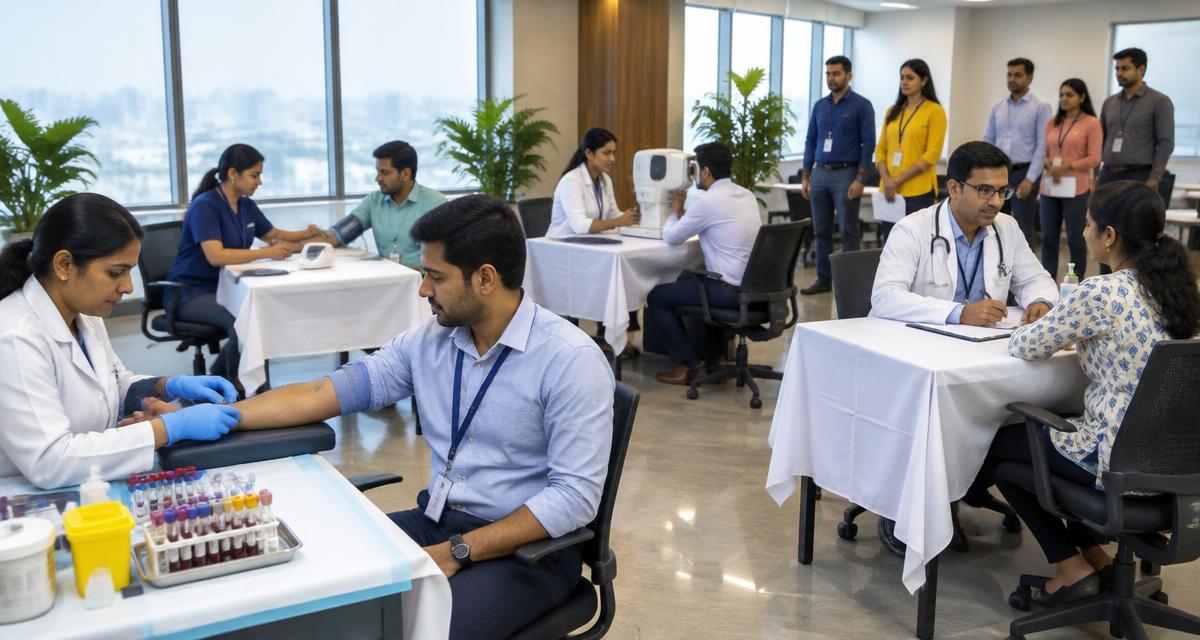
Buying employee health checkups in India is genuinely confusing. Every vendor quotes a different panel, a different price and a different definition of "comprehensive", and HR is left comparing 62-test lists without knowing which tests matter for which employee. This guide gives you a practical way to structure the programme, budget it and compare proposals — written for HR, admin and EHS heads, not for doctors.
Start with why: preventive, statutory or pre-employment
The first mistake buyers make is treating all checkups as one product. In practice you are buying three different things. Preventive annual checkups find lifestyle disease early in your general workforce. Statutory medical examinations are mandatory for workers in hazardous processes under the Factories Act, 1948 and your state factory rules, with prescribed frequencies and registers. Pre-employment checkups answer a hiring question: is this candidate fit for this specific job? A good vendor prices and delivers these separately, because the tests, the paperwork and the doctors involved are different. You can see how employee health checkup packages split by industry, hazard and age band on our checkup pages.
What a sensible panel includes
Resist the temptation to buy the longest test list. A practical Indian corporate panel layers four groups: a base screen for everyone, additions by age and gender, additions by hazard, and doctor review on top.
- Base screen for all adults: blood group, haemoglobin, blood sugar (fasting or HbA1c), lipid profile, liver and kidney function, urine routine, blood pressure, BMI and vision.
- Age and gender additions: thyroid (TSH) from the early thirties, ECG from 35–40, PSA for men and mammography or sonography-based women's screening in the 40+ bands, bone health for women over 45.
- Hazard additions: audiometry and lung function (spirometry) for noise and dust exposure, chest X-ray for respiratory hazards, and the specific tests your certifying surgeon requires for the hazardous-process schedule your plant falls under.
- Review: every report read by a physician who records a fitness or follow-up opinion, not just a lab PDF.
NABL-accredited labs matter here. Test quality varies more between labs than prices do, so ask which lab processes the samples, whether it is NABL accredited, and how quality control is documented.
What it should cost
Indian corporate pricing is volume-driven, and honest vendors will tell you the band rather than hiding behind an MRP. In our experience, basic onsite screening for a young, desk-based workforce lands in the low hundreds of rupees per employee per year, a standard adult panel with ECG and thyroid sits in the ₹1,000–2,500 band, and statutory hazard-specific examinations cost more because they include audiometry, spirometry, X-rays and certifying-surgeon time. Be suspicious of quotes far below these bands — the usual shortcuts are non-NABL labs, unqualified sample collectors or panels padded with cheap, low-value tests. Our corporate health checkup packages publishes package prices openly, from ₹199 per employee per year for basic onsite screening.
Onsite camp or partner lab?
Run an onsite camp when you want participation — shop-floor teams, shift workers and anyone who will not travel to a lab on a weekend. Camps typically need 20–30 minutes per employee, a clean room, and a phlebotomy team sized to your headcount; radiology and specialised imaging are scheduled at a partner centre. Lab appointments work well for head-office populations and for senior leadership who prefer privacy. Most of our clients do both: camp at plants and warehouses, lab slots at offices. Either way, let employees pick their own slot — participation is a logistics problem far more than a motivation problem.
How to compare vendors in one page
Ask every bidder the same six questions and put the answers side by side. Which lab processes the samples, and is it NABL accredited? Who reviews the report, and what opinion do they record? What is the turnaround from sample to digital report? How are abnormal findings followed up — is there a consultation pathway, or does the journey end at the PDF? What statutory documentation do you provide for our state and hazard category? And what does HR actually receive — an anonymised dashboard with participation and risk trends, or a folder of individual PDFs?
That last question matters more every year. Under the DPDP Act, 2023, employee health data is personal data; the right structure is consent-based records the employee owns, with HR seeing aggregates only. A vendor who emails individual spreadsheets of cholesterol values to HR is creating a compliance problem for you.
Getting started
Start with a health risk assessment to learn where your risk actually sits, then buy the tests the data points to instead of a standard panel for everybody. You can enrol your company free, run assessments for your first 25 employees at no cost, and our corporate health team will send a checkup proposal matched to your headcount, locations and statutory needs within one working day.
Common mistakes when buying checkup packages
The most frequent mistake is buying on test count alone. A package with sixty parameters looks generous, but many of those parameters are sub-values of the same blood test, and none of them help if nobody explains the report or follows up on abnormal results. Compare packages on three things instead: whether the tests match the age, gender and job risks of your workforce; whether a doctor reviews every report and gives a clear fit, follow-up or refer opinion; and whether abnormal results trigger a consultation, a diet plan and a re-test rather than a PDF that sits in an inbox.
A second mistake is treating the checkup as a single event. Employees who are flagged with high sugar, high blood pressure or abnormal cholesterol need a second touchpoint within weeks, not a year later. Ask any vendor how they track follow-through, what share of flagged employees actually complete a consultation, and how re-test results are reported back to HR in anonymised form.
A third mistake is ignoring logistics. Camp dates that clash with shift changes, fasting instructions sent too late, or reports delivered only in English to a multilingual workforce all reduce participation. Plan the camp calendar with plant or office heads, send reminders in local languages on WhatsApp and SMS, and keep a mop-up day for employees who missed the first slot.
- Match tests to age, gender and job risk, not to a headline parameter count.
- Insist on a doctor opinion and a follow-up path for every abnormal result.
- Plan logistics, reminders and a mop-up day before the camp, not after.
Plan My Health delivers corporate health checkup packages, employee health checkup test list and prices and health risk assessment for employees for companies across India — talk to our corporate health team for a proposal matched to your workforce.
Share this article
Pick a tagline
The highlighted image above appears automatically as the preview picture on WhatsApp, LinkedIn and Facebook.
Related services
Want this for your workforce?
Start free with 25 employee health risk assessments and a corporate dashboard.
Get started for corporates