
Employee Health Checkup Camp at the Workplace: A Step-by-Step Guide for HR
Last updated 11 October 2026
Plan an onsite employee health checkup camp step by step: tests by role, scheduling, space, consent and privacy, reports and follow-up for HR teams in India.
By the Plan My Health corporate health team
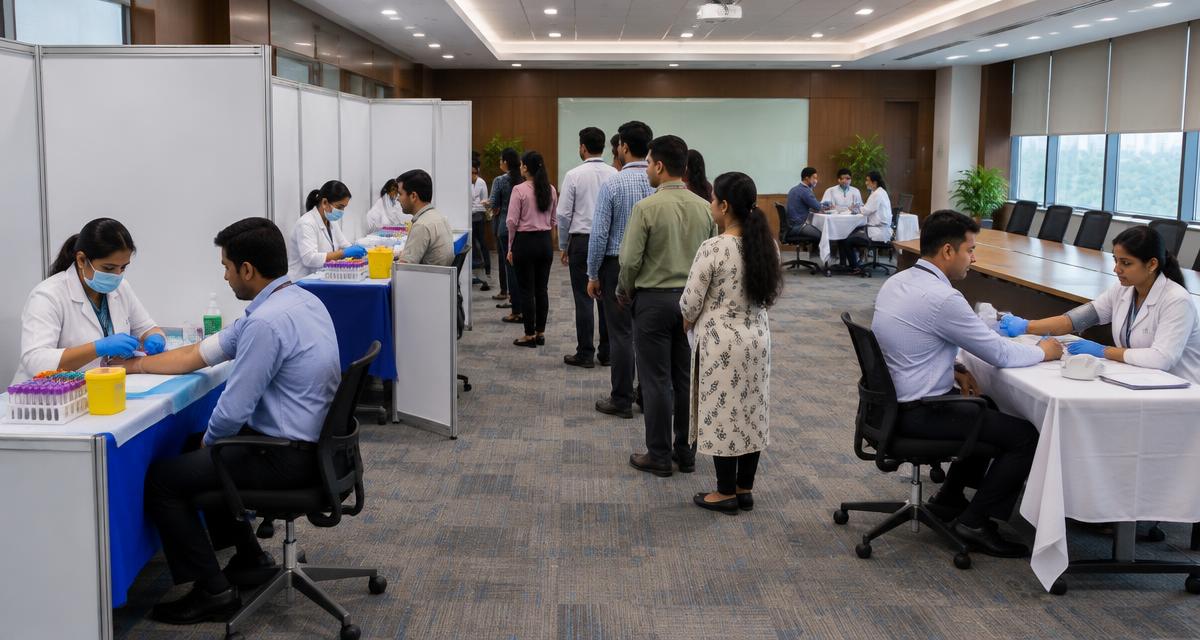
An onsite employee health checkup camp brings phlebotomists, technicians and a doctor to your office, factory or site, so employees finish their annual checkup in about 30 minutes without visiting a lab. A good camp is planned 3–4 weeks ahead, uses tests matched to each job role, protects privacy, and ends with a follow-up for anyone whose results need attention.
Step 1: Decide who is covered and why
List employee groups by role and risk: office staff, field sales, drivers, shop-floor workers, night-shift staff, canteen handlers and contract workers. Note any statutory medicals (for example, hazardous-process workers in factories or food handlers) so the camp covers them in the same visit.
Step 2: Choose tests by role
| Group | Core tests | Add-ons to consider |
|---|---|---|
| Office staff | CBC, fasting sugar/HbA1c, lipid profile, liver and kidney function, thyroid, urine, BP, BMI | Vitamin D and B12, ECG for 40+, eye test |
| Factory workers | Core tests + vision, audiometry, lung function (PFT), chest X-ray where exposure exists | Tests specific to the chemicals handled |
| Construction workers | BP, sugar, CBC, vision, fitness for work at height | Hearing, tetanus status, heat-stress screening |
| Drivers and forklift operators | Vision including colour vision, BP, sugar | Sleep-apnoea screening questions |
| Food handlers | Physical examination and tests required by food safety rules | Stool and skin checks as advised by the doctor |
Keep the core panel the same for everyone so year-on-year comparison is possible.
Step 3: Plan the logistics
- Space: a room for registration, two to four sample-collection booths, a private room for doctor consultation, and an area for ECG or vision tests.
- Throughput: plan how many employees each booth can handle per hour and schedule slots by team, so no line forms.
- Fasting: schedule fasting tests in the morning, and arrange breakfast after sample collection.
- Shifts: for factories, run sessions at the start of each shift or hold separate days for night staff.
Step 4: Consent and privacy
Take written or digital consent from every employee before samples are taken. Individual reports go only to the employee and the doctor. HR should see only anonymised, aggregated results (for example, "28% of employees have high BP"), in line with India's Digital Personal Data Protection Act. Say this clearly in the invitation — trust drives participation.
Step 5: Drive participation
- Announce the camp two weeks ahead, with a booking link and a reminder the day before.
- Let managers block calendars for their teams.
- Explain that the checkup is free, confidential and quick.
- Include contract workers wherever possible; health risks do not stop at the payroll line.
Step 6: Reports and follow-up
- Digital reports to each employee within a few days, with a plain-language summary.
- Doctor consultation (onsite or tele) for every employee with abnormal results.
- A dashboard for HR showing risk groups, participation by department and comparison with last year.
- Targeted programmes for the biggest risks: diabetes and BP follow-up, weight management, or health talks.
Common mistakes to avoid
- Choosing the cheapest package without tests for the job's real risks.
- Sharing individual results with managers.
- No follow-up, so abnormal results stay in an inbox.
- Changing the lab panel every year, making trends impossible to read.
How Plan My Health helps
Plan My Health runs onsite employee health checkup camps for offices, factories and construction sites across India, with role-based packages, digital reports and HR dashboards. See employee health checkup packages, employee health checkup in Mumbai and health checkup for factory workers.
FAQs
How many employees can a one-day camp cover?
It depends on the number of collection booths and staff. Plan slots per booth per hour and add booths or days for larger teams.
Is an annual health checkup mandatory for employees in India?
It is mandatory for certain groups, such as workers in hazardous processes under factory rules and other notified categories, so check the rules for your state and industry. For other employees it is a benefit many employers choose to offer.
Can family members join the camp?
Some companies extend the camp or a discounted package to families. It is easier to run as a separate session or through partner labs.
How should HR use the results?
Look only at anonymised trends: participation, top risk factors and change over time. Use them to choose wellness programmes for the year.
What is the difference between a camp and lab-visit checkups?
A camp brings collection to the workplace in a planned window. Lab visits let employees book individually at a partner centre, which suits remote or small teams.
Share this article
Pick a tagline
The highlighted image above appears automatically as the preview picture on WhatsApp, LinkedIn and Facebook.
Related services
Want this for your workforce?
Start free with 25 employee health risk assessments and a corporate dashboard.
Get started for corporates