
Stress Management Workshops for Employees: What Actually Works
Last updated 11 October 2026
Stress workshops work when they are practical, short, tailored to the audience and followed by support. Here is what to include, what to avoid and how to tell whether your workshop helped.
By the Plan My Health corporate health team
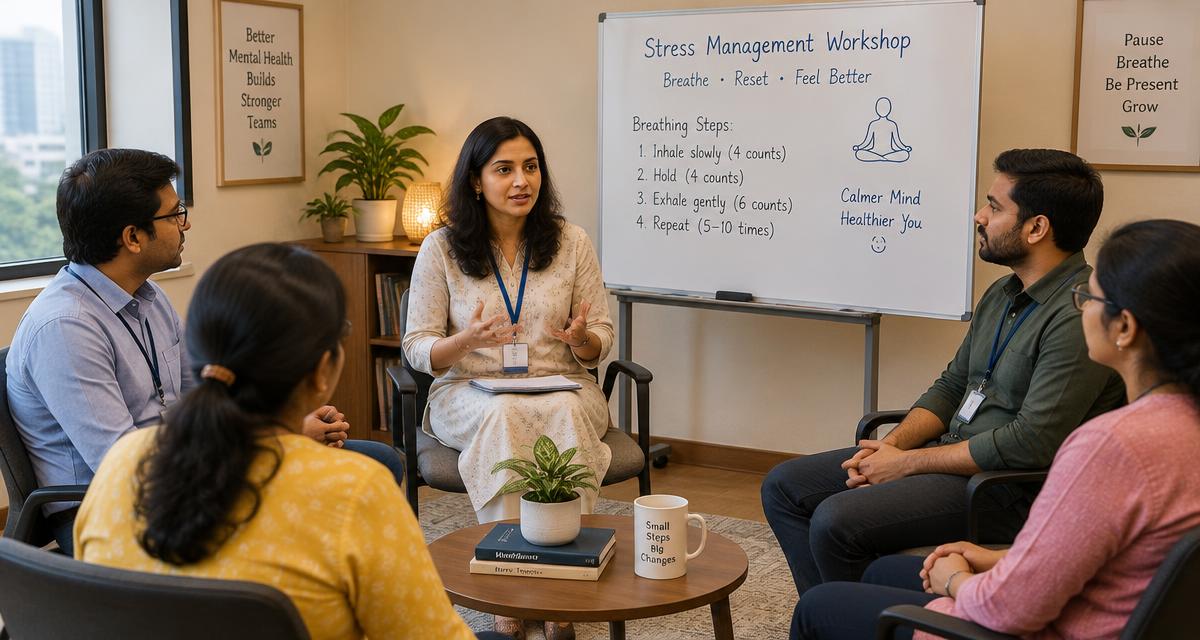
A stress management workshop works when employees leave with two or three techniques they have actually practised, when the content fits their real pressures, and when there is a clear route to confidential support afterwards. Workshops that are long lectures, generic slides or one-off events with no follow-up rarely change anything. This guide explains what to look for, what to avoid and how to measure the result, drawing on how we plan stress management workshops for employees in India.
If you want to understand how stress and other mental-health risks show up across your workforce first, read our guide to employee mental health screening at work.
What a good stress workshop looks like
The best workshops follow a simple pattern: a short, relatable explanation of what stress does to the body and mind; a technique; practice; a second technique; practice; and a plan for when to use them. The input should take less time than the practice. Employees should be able to name what they will try tomorrow before they leave the room.
Practical techniques that work in a workshop setting
- Slow breathing with a longer exhale: easy to teach, works at a desk or on a shop floor, and gives a quick sense of control.
- Grounding: noticing what you can see, hear and feel to step out of a spiral of worry.
- Thought checking: spotting the 'always' and 'never' thoughts that make a hard day feel hopeless, and trying a more balanced one.
- Task triage: sorting the day's work into what must be done, what can wait and what can be handed back.
- Boundaries: agreeing simple rules for after-hours messages and breaks, especially for hybrid teams.
- Sleep basics: a wind-down routine, light and screen habits, and — for shift workers — sleep after a night shift.
Tailor the workshop to the audience
Stress looks different in different jobs, and a workshop that ignores this feels irrelevant. Brief the facilitator on what your teams are dealing with.
Managers
Managers need two things: managing their own stress and supporting their team. A manager session should cover noticing changes in a team member, starting a supportive conversation, listening without fixing, and knowing where to refer someone confidentially. It should not turn managers into counsellors.
Shift and factory workers
For shift teams, keep it to 15 or 20 minutes at shift start, on paid time, in the language workers use, with demonstration rather than slides. Focus on sleep after nights, fatigue, anger and avoiding tobacco or alcohol as a way to cope. Run it for every shift, not just the day shift.
Sales and customer-facing teams
Sales, support and collections teams need ways to recover between difficult calls or visits and to stop carrying the day home. Online formats at the start of the day suit teams on the road.
Hybrid and remote employees
Remote employees often struggle with blurred boundaries and isolation. Workshops can cover setting start and stop times, managing notifications and staying connected to colleagues.
What to avoid
- Long lectures: an hour of slides on stress hormones does not change behaviour.
- Forced sharing: asking employees to discuss personal problems in front of colleagues breaks trust and can cause harm.
- Blaming the individual: if workload or a manager is the cause, telling people to breathe deeply will feel dismissive. Acknowledge work factors and pass anonymised themes back to HR.
- One-off events: a single workshop with no follow-up is easily forgotten.
- Wrong timing: scheduling a stress workshop at 7 pm after a long day sends the wrong message.
Who should lead it
Stress workshops should be led by a psychologist or counsellor with experience of workplace groups. They know how to keep the session safe, notice someone who is struggling and offer a private word afterwards. A trainer without that background can deliver tips, but may not handle a difficult moment well.
Psychological safety
Make it explicit at the start that nobody will be asked to share anything personal, that exercises are optional and that questions can be asked anonymously. Consider separate sessions for managers and their teams on sensitive topics, so people can speak freely. The facilitator should stay for a few minutes afterwards for anyone who wants to talk privately.
Follow-up support
A workshop opens a door; there needs to be something behind it. Tell employees how to reach confidential counselling where it is part of your benefits, how to book a doctor consultation for sleep problems or physical symptoms, and when the next session is. A short take-away summary — a single page or a WhatsApp-friendly message — helps people remember the techniques.
Building a series rather than a one-off
A sequence of three or four short sessions over a month — stress basics, sleep, boundaries and resilience — builds habits better than a single long workshop. Link it to the wellness calendar: World Mental Health Day in October, the period before year-end or appraisals, and after any major change are natural moments. Combine it with gentle movement such as office yoga sessions, which many employees find easier than sitting still to meditate.
How to tell whether it worked
- Attendance: the share of invited employees who came, by team and shift.
- Confidence pulse: one question before and after — 'How confident are you in managing stress at work?' on a simple scale.
- Next steps: aggregate uptake of counselling or consultations in the following weeks.
- Repeat requests: teams asking for a follow-up session are a strong sign of value.
- Trend over time: change in stress and sleep indicators between health risk assessments.
Never report who used counselling or what anyone said in a session. Aggregate numbers are enough to judge the programme.
A sample 60-minute workshop plan
- 0–10 minutes: welcome, ground rules and a quick anonymous poll on current stress.
- 10–20 minutes: how stress shows up in body, thoughts and behaviour, with workplace examples.
- 20–30 minutes: technique one — slow breathing — with practice.
- 30–40 minutes: technique two — thought checking or task triage — with practice in pairs, by choice.
- 40–50 minutes: building a personal plan: when and how to use the techniques.
- 50–60 minutes: questions, where to get support and the next session date.
How Plan My Health helps
We run stress management workshops onsite, online and hybrid across India, led by psychologists and counsellors and tailored to managers, shift teams and sales staff. They sit inside a wider programme of wellness sessions for employees, with anonymised reporting for HR.
FAQs
How long should a stress management workshop be?
Usually 45 to 60 minutes, or 15 to 20 minutes at shift start for factory teams. A short series often works better than one long session.
Who should run a stress workshop?
A psychologist or counsellor experienced with workplace groups.
Should employees share their problems in the workshop?
No. Exercises should be optional and private, with confidential support offered afterwards.
How do we measure a stress workshop?
Attendance, a before-and-after confidence question, aggregate counselling uptake and stress indicators between assessments.
Do stress workshops work for factory workers?
Yes, if they are short, held on paid time at shift start, in the workers' language and focused on sleep, fatigue and coping.
Share this article
Pick a tagline
The highlighted image above appears automatically as the preview picture on WhatsApp, LinkedIn and Facebook.
Related services
Want this for your workforce?
Start free with 25 employee health risk assessments and a corporate dashboard.
Get started for corporates