
Construction Site Medical Requirements in India: A BOCW Checklist for First Aid, Ambulance and OHC
Last updated 11 October 2026
First aid, trained first-aiders, ambulance and occupational health service at construction sites under the BOCW Act. A practical checklist for site managers.
By the Plan My Health corporate health team
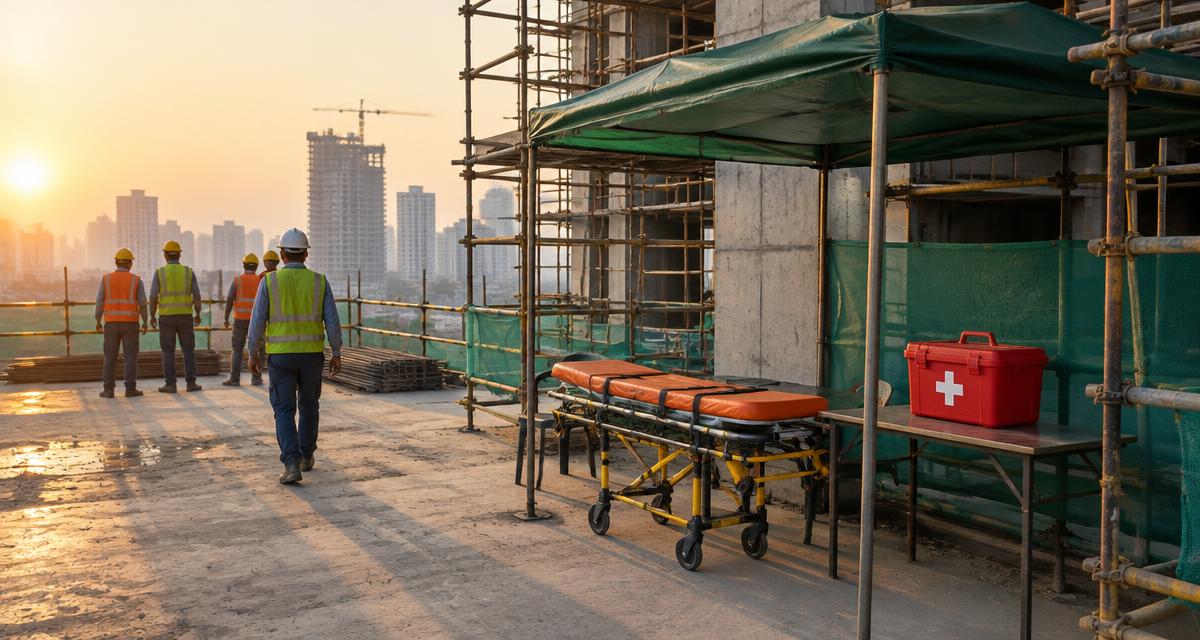
Every construction site in India with 10 or more building workers falls under the Building and Other Construction Workers (BOCW) Act, 1996, and must provide first aid, a plan for getting injured workers to hospital, and — on larger sites — an occupational health service. This guide turns those duties into a checklist a site manager or EHS head can act on this week.
Why construction needs its own medical plan
Construction is not a factory with a fixed floor plan. The site changes every month, workers rotate between contractors, many live in labour camps, and the nearest hospital may be 30 minutes away through traffic. Falls from height, crush injuries, electrical shocks, heat stress and dehydration are the most common emergencies. A medical plan that worked at the excavation stage often fails at the superstructure stage, so it has to be reviewed as the site grows.
What the BOCW framework expects
The BOCW Act and the BOCW (Central) Rules, along with the state rules that apply where your site sits, set out the employer's health duties. In plain terms:
- First aid boxes stocked to the scheduled list, placed where workers can reach them quickly, and kept in the charge of a trained person.
- Trained first-aiders on every shift, in proportion to the number of workers.
- Arrangements to move injured workers to hospital — a vehicle or ambulance arrangement and a named hospital.
- An occupational health service at the site on establishments covered by the rules on medical services, including medical examination of workers.
- Records of injuries, dangerous occurrences and medical examinations, kept ready for the inspector.
The Occupational Safety, Health and Working Conditions Code, 2020 brings the BOCW and Factories Act duties under one code. The thresholds and schedules can differ by state, so confirm the exact numbers for your project with your safety officer or labour consultant.
The 10-point site medical checklist
- Register the establishment under BOCW before work begins and display the registration.
- Map the nearest hospitals: one trauma-capable hospital and one general hospital, with phone numbers, travel time at peak hour and a printed route.
- Stock first aid boxes to the scheduled contents, with a monthly expiry check and a refill log.
- Train first-aiders on every shift, including night pours. Certificates should be current and the names displayed near each box.
- Set up a first aid room or medical post once the workforce is large enough, with a stretcher, oxygen, BP apparatus, glucometer and a dressing table.
- Station a nurse or paramedic during high-risk phases (piling, structural work, work at height) and a visiting MBBS doctor for weekly OPD and fitness checks.
- Arrange an ambulance: a retained BLS ambulance on site for large projects, or a written on-call agreement with a guaranteed response time for smaller ones.
- Run pre-placement and periodic medicals: vision, BP, blood sugar, fitness for work at height, and vertigo screening for scaffolders and riggers.
- Prevent heat illness from March to June: shaded rest areas, ORS, water every 20 minutes, adjusted shift timings and supervisors trained to spot heat exhaustion.
- Keep records inspection-ready: injury register, first aid log, medical examination records and ambulance trip log.
Nurse post, OHC or full medical team: which one fits?
| Site size and risk | Typical setup |
|---|---|
| Small site, low height work | First aid boxes, trained first-aiders, on-call ambulance, hospital tie-up |
| Mid-size site, several contractors | Medical post with a nurse on day shift, weekly doctor visit, on-call ambulance |
| Large or high-rise site, labour camp | Occupational health centre with nurses across shifts, MBBS/AFIH doctor, retained ambulance |
Common gaps inspectors and auditors find
- First aid boxes locked in the site office with no key on night shift.
- First-aider certificates expired or the trained person moved to another site.
- No written hospital route; the ambulance driver does not know the trauma centre.
- Medical examinations done once at joining and never repeated.
- Contractor workers left out of the medical plan because "they belong to the subcontractor".
How Plan My Health supports construction sites
Plan My Health sets up and runs site medical posts and occupational health centres, supplies nurses and doctors, arranges standby ambulances and trains first-aiders in Hindi, Marathi and English. See OHC for construction sites, ambulance for construction sites and first aid training for construction sites.
FAQs
Does the BOCW Act apply to my site?
It applies to establishments employing 10 or more building workers on any day in the preceding 12 months. Most commercial and residential projects qualify.
Is an ambulance mandatory at every construction site?
Every site must have a way to move an injured worker to hospital quickly. Larger sites usually retain an ambulance on site; smaller sites can use a written on-call arrangement with a guaranteed response time.
Who should be trained in first aid at a construction site?
Supervisors, foremen, safety stewards and at least one person per shift per work area. Training should include CPR, bleeding control, fractures, burns, electric shock and heat illness.
Do subcontractor workers need medical examinations?
Yes. The principal employer is responsible for safety and health of everyone working on the site, including contract labour.
Can the site OHC also run health checkups for staff?
Yes. A site OHC can run pre-placement medicals, periodic checkups and health talks for both staff and workers.
Share this article
Pick a tagline
The highlighted image above appears automatically as the preview picture on WhatsApp, LinkedIn and Facebook.
Related services
Want this for your workforce?
Start free with 25 employee health risk assessments and a corporate dashboard.
Get started for corporates